

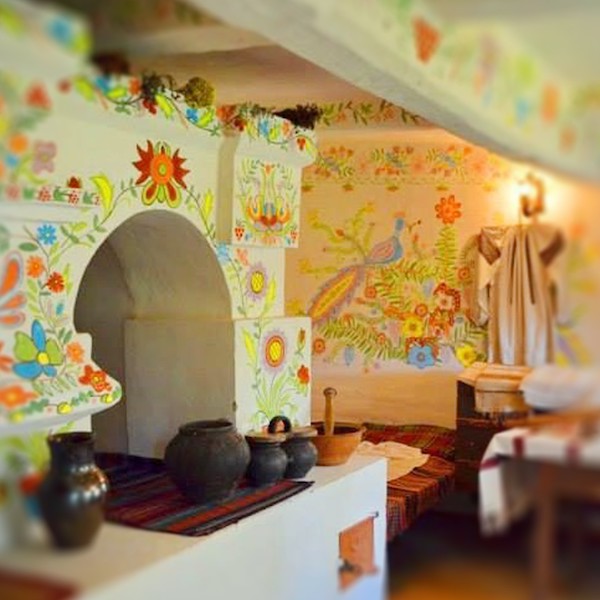
Home heating systems are part of the everyday life and development of any nation. We have already written about the traditional wood-burning stove. The subject of today's journey back in time is the hruba, also called hrubka — the local equivalent of what is known elsewhere as a tiled stove.
What was a hrubka — the old appliance for heating a home?
A hruba, or hrubka, was an old domestic stove fired with wood or coal, normally used to heat the living space and — if it had a convenient top surface — for cooking as well.
It became widespread in Ukraine at the end of the 19th century. At first it was built of unfired brick, later of refractory brick. Its form, dimensions and construction were arbitrary.
Initially the hrubka, in the shape of a rectangular column, was built onto the side of the main stove. It had a separate flue that ran to the stove's chimney and out of the building. To heat the walls better and retain more warmth, the flue ducts were built with vertical turns: up — down — up.
How was a hrubka built and how did it work?
The construction of a hrubka included the following elements:
- The firebox, where combustion takes place
- The air inlet — the opening between the firebox and the ash pan, covered by the grate
- The grate — cast iron bars on which the fuel burns
- The flue — the duct that carries the smoke away from the stove
- The chimney throat — the lower part of the chimney
- The ash pan — the recess under the grate into which ash falls from the firebox
- The top plate — the upper surface of the stove, intended for cooking
- The oven — a recess in the stove next to the firebox, closed by a door, used for cooking
- The door — the element that closes the firebox opening
- The opening in the flue where the damper sits
- The damper — the slide that shuts off the flue
The working principle of the hrubka is similar to the one used today in modern fireplace inserts and stoves. Brick hrubka stoves were designed so that the air supply could be regulated during burning. The way the firebox was laid ensured almost complete combustion of various fuels without restricting the air supply. Making the most of the temperature of the hot gases allowed heat to be released over a long period without constant refuelling, while the temperature of the stove's stone surface stayed safe to touch.
As houses changed and more rooms were built, the hrubka was built as a separate column in one room, or set into an internal wall so that it could heat two rooms at once.
Until the 1930s and 1940s the hrubka served only to heat the room. Later a metal plate was added above the combustion chamber. That made it possible not only to heat the house but also to cook. The surface of the hrubka was plastered with clay and whitewashed, or faced with tiles.
To this day such stoves can still be found in many homes across the country.
What survives of that design in a modern fireplace?
Surprisingly much. The grate, the ash pan, the adjustable air supply, the flue damper and the heat-accumulating plate all still work today, only in a different form. The role of the brick mass has been taken over by the fireclay lining of the combustion chamber, and instead of vertical turns in the duct a double deflector is used to lengthen the path of the hot gases inside the appliance.
What has also changed is what used to be the biggest drawback: today the heat is carried from the surround into the room by ventilation grilles, and the smoke is taken away by certified modular chimney systems instead of a masonry channel that had to be taken apart to be cleaned. If an old open stove or fireplace is still standing in the house, it can be closed by fitting a fireplace cassette into the existing surround.
SAVEN — telling the story of fire at home
READ ALSO: