

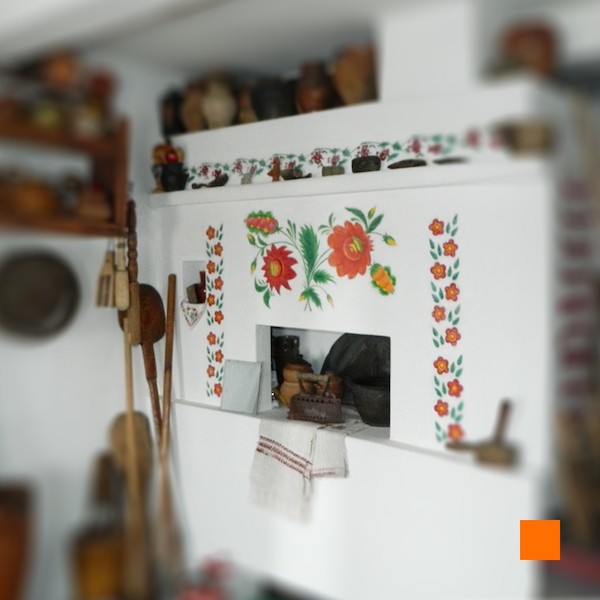
Have you heard of heating "the black way" and "the white way"? Do you know what a traditional Ukrainian stove looked like? Folk history has taken on a particular significance lately, so we decided to tell you about the part of it that is close to our company — the traditional heating systems our ancestors used.
The traditional Ukrainian stove
The heart of a Ukrainian house was the stove, also called pich or pichka. "On the stove it is always red summer," people used to say, meaning that in one's own home it is always warm and comfortable.
The stove heated the room; bread was baked in it, food was cooked on it, people slept on it, and clothes, medicinal herbs and grain were dried on it. Countless songs, fairy tales, stories and myths were composed about it. Who does not remember the tale of the boy whom the witch wanted to throw into the stove? Or the legend of the household spirit that lives by the hearth?
What was the stove not, in the old days: a source of heat, a bed, a cooking surface, a place for baking and drying — and even a medicine cabinet! It was on the stove, or above it, that our ancestors dried the herbs they had gathered and later used as medicine.
What kinds of stove heating existed in the past?
The first were stone stoves, known to archaeologists from the early Slavic period of the 5th–7th centuries. They were built of stone, had an oval or round shape and stood in the middle of the dwelling.
Next came the smoke (black) stove — a stove of rammed clay whose smoke came out straight into the room. From there it rose to the ceiling and left either through the windows or through small openings high in the walls. A house heated this way was called a "smoky" or "black" house, that is, one heated "the black way". And all because the smoke blackened the ceiling and the walls. From those times comes the saying "From your own stove even the smoke is not bitter".
In time the smoke began to be led into the entrance hall or up to the roof through special openings and ducts. That was the half-smoke stove.
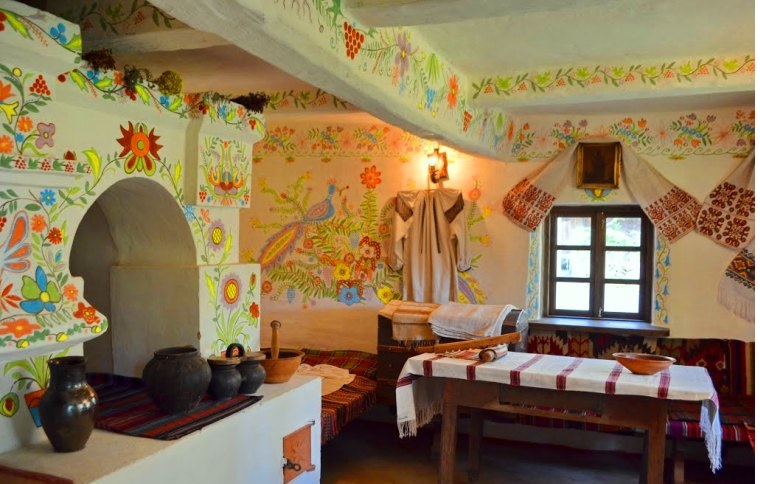
Later, chimneys began to be built, through which the smoke left the stove and the building altogether. This variant was called heating "the white way". Can you guess why?
It is worth adding that while in the villages of some neighbouring countries black houses without an extract flue still predominated until the middle of the 19th century, and sometimes into the early 20th, Ukrainian villages were already building transitional stoves in the 19th century — moving from the flueless black stove to the white stove with a chimney.
Heating "the white way" made Ukrainian homes not only warm and comfortable but also clean. Whitewashed walls, a clean earthen floor, wall painting (think of the distinctive Petrykivka style) — all of this clearly set these houses apart.
The first written mentions of houses heated "the white way" appear in descriptions of the castles of Skala and Smotrych from the 15th century.
What is left of that tradition today?
The principle has stayed the same: the fire should give its heat to the room, and the smoke should leave through the chimney. Only the technology has changed. The rammed-clay stove has been replaced by closed fireplace inserts and stoves with heat-resistant glass, in which most of the heat returns to the house instead of escaping up the flue, while the simple old channel has given way to certified modular chimney systems. Where warmth once simply radiated from heated clay, the job today is done by ventilation grilles in the fireplace surround.
SAVEN — keeping our heritage alive!
* Materials used in this article:
- Radovych R. Development of the heating system of the Polissian dwelling: ways of removing smoke
- Syvak V. General characteristics of the interior of the folk dwelling of the Ukrainians of the Carpathians, late 19th – first half of the 20th century
- Siletskyi R. Traditional building rituals of the Ukrainians
- Fedaka P. Internal layout and interior of the folk dwelling of Zakarpattia