

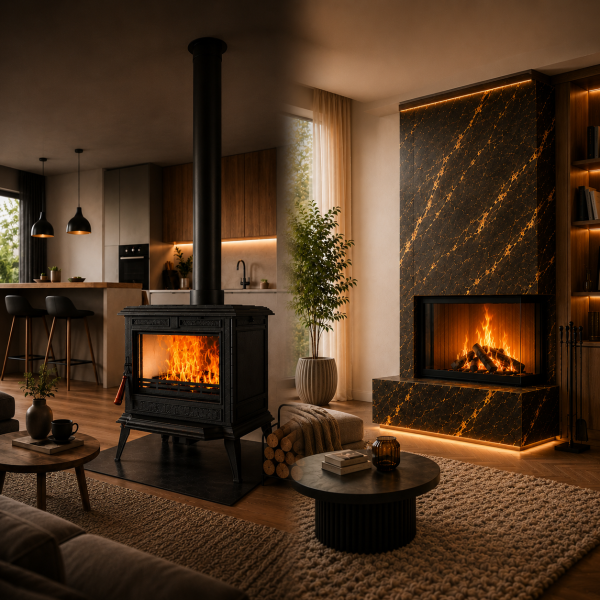
When choosing a heating system for a country house, many homeowners ask themselves: fireplace or stove — which is better for comfort, warmth, and efficiency? Both options have their own advantages, features, and areas of application. In this article, we will look at the main differences, pros and cons, and help you determine which solution is best suited for your private home.
What is the difference between a fireplace and a stove?
Fireplace — aesthetics and atmosphere
A fireplace for a home is not only a source of heat but also an important interior design element. Modern fireplaces create a cozy atmosphere, add a premium look to the room, and become the focal point of the living area.
Main advantages of a fireplace:
- stylish modern design;
- live fire effect;
- fast room heating;
- easy integration into modern interiors;
- increased property value.
Modern fireplace inserts with closed glass doors have high efficiency and can effectively heat a house. Particularly popular today are turnkey fireplaces, which include design, installation, and portal finishing.
In the SAVEN catalogue, steel inserts are divided into several lines: straight — when the fireplace stands against a wall, corner — when the fire should be visible from two sides, SAVEN Energy Up with a guillotine door that lifts upwards, and the SAVEN Balance series. Output, efficiency, and the recommended flue diameter differ from model to model — they are listed in the product specifications.
Stove — practicality and long-lasting heat
A stove for a private house is a traditional and highly effective heating solution. Stoves accumulate heat very well and continue to release it long after the firewood has burned out.
Advantages of a stove:
- long-lasting heat retention;
- economical firewood consumption;
- high heating efficiency;
- ability to heat multiple rooms;
- independence from electricity.
Modern cast iron stoves and steel stoves differ greatly from old bulky constructions. They feature stylish designs, compact dimensions, and high efficiency ratings.
Cast iron and steel behave differently: KAWMET cast iron inserts and stoves and MORSO cast iron stoves take longer to heat up but release the accumulated heat for longer once the wood has burned down, while SAVEN steel fireplace stoves warm a room faster. The warranty on MORSO stoves is 10 years; on SAVEN steel inserts and stoves it is 5 years plus an additional 2 years on the fireclay lining.
Which heats better: a fireplace or a stove?
If the main goal is the most efficient heating possible, a wood-burning stove often has the advantage. It holds heat longer and is better suited to permanent living.
That said, a modern fireplace with a water jacket or a powerful fireplace insert can also provide full-scale heating for a house.
It is important to consider:
- the floor area of the house;
- thermal insulation;
- the number of rooms;
- how often the house is occupied;
- the desired interior design.
For example:
- for a summer house or a weekend home, a stove is often chosen;
- for permanent living — a fireplace or a combined system.
How does a built-in fireplace differ from a freestanding stove?
Rather than comparing them in general terms, we have gathered the key differences in one table. This compares an insert built into a finished surround with a ready-made fireplace stove placed freestanding in the room.
| Criterion | Fireplace (insert in a surround) | Fireplace stove |
|---|---|---|
| Heat-up speed | Heats the room quickly: warmth radiates through the glass and leaves the surround through ventilation grilles | Takes longer to heat up, but keeps releasing heat after the firewood has burned out |
| Installation location | Planned in advance: a surround is built around the insert and finished, most often in the living room | Placed on a ready non-combustible base; takes up less space and requires far less construction work |
| Flue requirements | The chimney is planned during construction or renovation; diameter according to the insert data sheet | Connected to an existing flue; diameter likewise according to the model data sheet |
| View of the fire | Panoramic glass, the fire becomes the centre of the living room; corner models show it from two sides | The fire is visible through a glazed door, with a smaller viewing area |
| Mobility | A permanent solution: once the surround is finished, the fireplace can no longer be moved | Relatively mobile: if needed, the stove can be disconnected and moved elsewhere |
For prices of specific models, please check with a manager or a representative in your region.
Fireplace or stove: comparing the costs
Installation cost depends on:
- the type of appliance;
- the complexity of the installation;
- the chimney;
- the surround finish;
- the heat output.
In most cases:
- a basic wood-burning stove costs less;
- a modern designer turnkey fireplace costs more because of the surround and decorative work.
Running costs
Both stoves and wood-burning fireplaces can be economical when the output is chosen correctly and the firewood is of good quality.
The most economical are considered to be:
- cast iron inserts and stoves;
- modern long-burning fireplace inserts;
- models with secondary combustion of flue gases.
What if the fireplace surround has already been built?
If an old open fireplace is already in place, there is no need to demolish it. A fireplace cassette is fitted into the existing surround — a closed firebox with a glazed door that slots into the masonry you already have. This turns an open hearth, which sends most of its heat straight up the chimney, into a closed combustion chamber — without rebuilding the fireplace or redoing the finish.
What to choose for a private house?
Choose a fireplace if what matters to you is:
- atmosphere and design;
- a panoramic view of the fire;
- a modern interior;
- fast heat;
- a premium look for the living room.
Choose a stove if what matters to you is:
- long-lasting heat;
- maximum practicality;
- economical use of firewood;
- primary heating for the house;
- independence from utilities.
The best solution is a combination
Today many homeowners install:
- a fireplace in the living room for atmosphere;
- a stove as the main heat source for one room.
This approach delivers both comfort and effective heating.
Conclusion
There is no single answer to the question "fireplace or stove — which is better?" Everything depends on your needs, budget, the style of your house, and how you live in it.
If you want to create a cozy modern interior and heat a whole house or a room, choose a fireplace for a private house based on a steel fireplace insert. If your main goal is efficient, economical heating of a single room, a better choice is a wood-burning stove: a steel fireplace stove, a KAWMET cast iron stove, or a MORSO cast iron stove.
Most important of all is choosing the right appliance and entrusting the installation to professionals. Quality installation and a well-thought-out design are what make a heating system safe, efficient, and durable.