

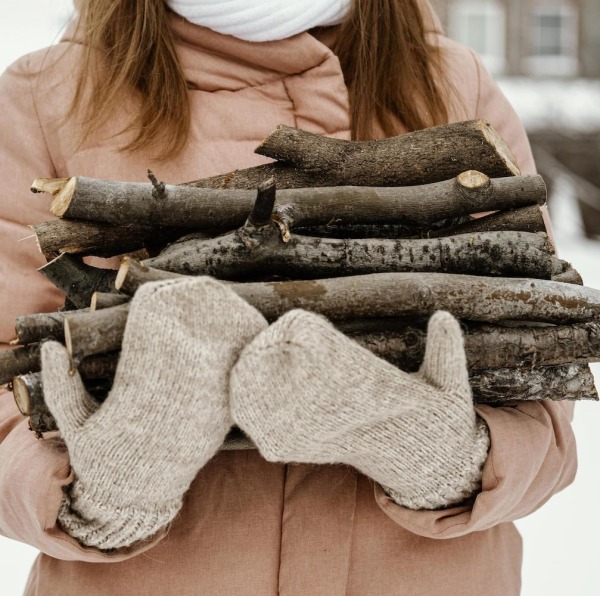
For fireplace owners, the question of how much firewood is needed for the winter is always relevant. An insufficient supply can leave you without heat on cold days, while overstocking takes up space and resources. In this article, we will explain how to properly calculate firewood, which factors affect consumption, and how to organize a winter firewood supply without unnecessary costs.
Why it’s important to plan a firewood supply
A fireplace is not only a source of coziness but also an additional heating option for your home. Improper planning of firewood supplies can lead to:
- feeling cold during the peak of winter;
- using wet or poorly dried wood, which worsens combustion;
- economic losses due to buying “on the spot” at inflated prices.
Proper firewood calculation helps ensure continuous warmth, optimize costs, and keep your wood storage organized.
Factors affecting firewood consumption
1. Fireplace power
The higher the nominal power of the fireplace, the more firewood is needed to maintain a comfortable temperature.
2. Type of wood
- Hardwoods (oak, beech, hornbeam) — burn slowly, provide stable heat;
- Softwoods (pine, spruce) — burn faster, but give more flames and aroma;
- Wood moisture — wet wood burns slower, produces less heat, and clogs the chimney.
3. Room size and ceiling height
- A large house requires more firewood to maintain the same temperature;
- High ceilings increase heat loss.
4. Intensity of fireplace use
- Fireplace for aesthetics and minor additional heating — less firewood;
- Fireplace as main heating — large supply required.
How to calculate firewood for winter: step-by-step guide
1. Determine the heated area
For a standard residential house:
- 50–70 m² — 1–1.5 m³ of firewood per month of active use;
- 100 m² — 2–3 m³ of firewood;
- 150 m² and above — 3–5 m³.
2. Consider the type of wood
Hardwoods — you can reduce the volume by 10–20%;
Softwoods — increase the supply by 15–20%.
3. Count the number of months of active heating
Winter in most regions lasts approximately 4–5 months;
Multiply monthly consumption by the number of months.
4. Add a reserve
To avoid running out of firewood on the coldest days, it is recommended to add an extra 10–15%.
Example calculation:
- House 100 m², fireplace with hardwood, active heating for 4 months;
- Monthly consumption = 2 m³;
- Total supply = 2 × 4 = 8 m³;
- Adding 10% reserve → 8.8 m³.
Organizing a winter firewood supply
1. Drying and storage
- Firewood should be well dried (moisture <20%);
- Store under a cover or in a wood shed;
- Ensure ventilation so that firewood does not rot or grow mold.
2. Divide into portions
- Do not pile all firewood into one large stack;
- Form stacks of 0.5–1 m³ for convenience;
- Use a wood shed or metal baskets for easier access to firewood for the fireplace.
3. Safety
- Distance from wood storage to fireplace — minimum 1 m;
- Do not store firewood near open flames;
- Check for insects or mold before use.
Tips for economical firewood use
Planning a winter firewood supply is a key step in preparing for the cold season. Proper firewood calculation depends on house size, fireplace power, type of wood, and intensity of use.
- Use hardwoods for long-lasting and stable burning.
- Add dry firewood gradually to avoid temperature drops in the combustion chamber.
- Check fireplace convection grilles and ventilation — proper heat distribution reduces firewood consumption.
- Use SAVEN fireplace accessories to more effectively control flame and temperature.
Following these simple rules ensures:
- stable warmth;
- economical use of firewood;
- comfortable and safe winter fireplace operation.
Now you know how much firewood is needed and can be confident that your home will stay warm even in the coldest freezes.