

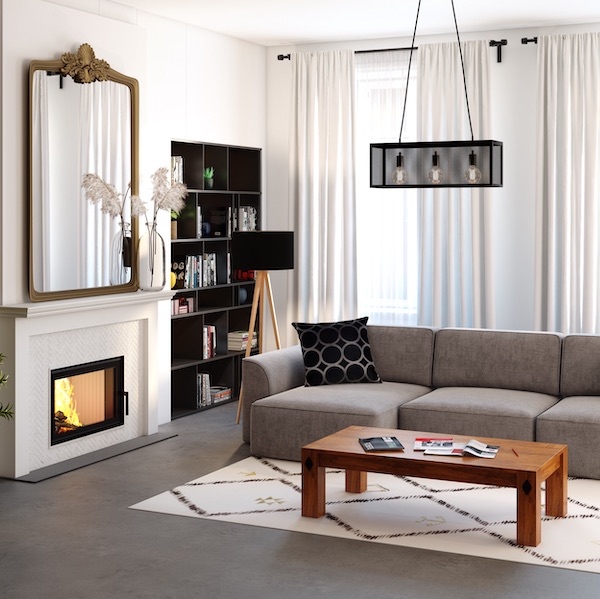
There is no accounting for taste. If you have set out to buy a fireplace insert and are asking yourself which is better — cast iron or steel, you are unlikely to find a single definite answer. Because it simply does not exist. Both cast iron and steel are ideal materials for making inserts. Otherwise they would not be so popular. So what to choose depends only on you.
All the same, in this article we will try to explain the difference between cast iron and steel inserts, so that you can buy a fireplace insert that is exactly right for your house.
Let us say at once: the SAVEN range includes both solutions. There is our own production of steel inserts — straight, corner, the Energy Up series with a guillotine door and Balance — and there are MORSO cast iron stoves (41 models) and KAWMET cast iron inserts and stoves (87 models). So the question worth asking is not "which is better in general" but "which is better for which task". That is exactly what we answer below.
How do you buy a fireplace insert: general advice
First of all it should be noted that fireplace inserts differ not only in the material they are made from. An insert should be chosen together with other parameters, such as:
- the type of fuel (wood, pellets, gas)
- the output and the ability to heat a maximum area
- the dimensions (height, width, depth, weight, flue diameter)
- the way it is positioned and the view of the fire (straight, corner, tunnel or three-sided inserts)
- the way the door opens (for closed inserts) — side-opening or guillotine
Cast iron or steel: how to choose an insert for a fireplace
Solid-fuel inserts (that is, those that burn wood) differ little in construction and operating principle, regardless of the material they are made from. Nevertheless, both cast iron and steel have their own features that affect the energy efficiency of the fireplace.
.jpg)
A cast iron insert: the characteristics and advantages of cast iron
Cast iron inserts and stoves began to be made as early as the start of the 19th century. To this day this is the classic type of insert, a kind of benchmark in the manufacture of fireplace appliances. But why is cast iron so popular?
Cast iron itself is an alloy of iron with carbon (more than 2% carbon by mass) and other elements. This material has maximum heat capacity and thermal inertia, which is extremely important for a heating appliance.
In simple terms, a cast iron insert warms up more slowly than a steel one — first the metal itself fills with heat — but it noticeably retains that heat for longer after the fire in the fireplace has gone out.
A cast iron fireplace spreads heat through the room softly and gently. The room warms evenly, and the temperature stays comfortable for many hours even when the fireplace is no longer burning. All of that is because cast iron accumulates heat in its walls and gives it off slowly. Thanks to the considerable thickness of those walls (from 8 to 14 mm), the insert can accumulate as much as possible of the heat produced by the fireplace.
A cast iron fireplace insert is resistant to temperature swings, so the probability of such an insert deforming is minimal. Cast iron is also not prone to corrosion, so such an insert will serve for a long time.
What is worth taking into account when choosing cast iron: such appliances are heavy, so installation demands attention to the load-bearing capacity of the floor where the fireplace is to stand. It is also worth thinking through the position in advance — moving a cast iron stove afterwards is harder than moving a lighter steel insert.
The technical characteristics of a cast iron insert
Most often fireplace stoves and inserts are made from what is known as vermicular, or grey, cast iron. This is a high-quality alloy of iron with carbon in which all the carbon, or part of it, is present in the form of graphite. Besides iron and carbon, such an alloy contains silicon, manganese, phosphorus and sulphur.
Vermicular cast iron is distinguished by high strength and heat conductivity. Fireplace inserts of this kind conduct heat well and give it off for several hours after the burning process.
A cast iron fireplace insert of vermicular cast iron has the following technical characteristics:
- The cast iron body of the fireplace appliance is dense and weighs no less than 100 kg;
- Double cast iron walls around the perimeter of the combustion chamber protect the body from overheating and deformation and allow the insert to be used in a continuous-burning regime;
- Dense vermiculite plates around the perimeter of the combustion chamber (the secondary gas combustion system);
- A system for drawing combustion air from outside;
- Sealing cords around the perimeter of the glass in the firebox door, which provide airtightness and keep the glass clear.
A steel insert: the characteristics and advantages of steel
Steel fireplace inserts in their time overturned the standard idea of what a fireplace should be. Soft and workable steel made it possible to design fireplace inserts in non-standard shapes and sizes, and the ability of steel to heat up instantly and give off heat turned steel fireplaces into a genuine trend in heating equipment.
Steel is an alloy of iron with carbon (from 0.02 to 2.14% carbon) and impurities (silicon, manganese, sulphur, phosphorus and gases). In order for a steel insert or stove to withstand large temperature swings, the steel for the bodies is smelted using a special technology. Whether the insert turns out heat resistant and durable depends precisely on the quality of that smelting and the uniformity of the material.
To improve the quality of the steel, the content of harmful impurities in the alloy is reduced, while alloying additives (from the Latin ligare, "to bind") are used to increase uniformity: they reduce grain size and improve the thermal stability of the material.
The alloying elements include:
- chromium (Cr) — increases hardness and strength, improves corrosion resistance
- nickel (Ni) — improves corrosion resistance, increases strength and ductility
- molybdenum (Mo) — increases elasticity, anti-corrosion properties and resistance to oxidation at high temperatures
- tungsten (W) — prevents grain growth on heating and helps eliminate brittleness
- vanadium (V) — increases hardness and strength, raises the density of the steel
- titanium (Ti) — increases the strength and density of the steel, improves corrosion resistance
- aluminium (Al) — increases the heat resistance of the steel
- copper (Cu) — improves corrosion resistance
In most cases alloying elements are added in insignificant quantities — tenths of a per cent (low-alloy steel), but some of them from a few per cent up to 10-15% and even more. Such steel is called high-alloy steel.
Low- and high-alloy steels have high heat resistance and heat conductivity. That property allows steel inserts and stoves to move heat from the body of the appliance into the room faster. The steel body is welded with sealed seams. That is more reliable than cast iron constructions sealed with sealant, which need replacing over time.
Another advantage of steel is its plasticity. That allows a wide variety of modern steel fireplace inserts to be designed and does not restrict the manufacturer in matters of design.
Read more about steel inserts in the article The advantages of a steel insert for a fireplace
The technical characteristics of a steel insert
Many people mistakenly believe that steel is a worse material for fireplace inserts than cast iron: it heats up quickly and cools quickly, and is less resistant to high temperatures. But a steel insert is not made from an ordinary sheet of metal. Its manufacture uses strong, heat-resistant alloyed boiler steel 3-5 mm thick.
The combustion chamber of steel inserts is fitted with thick protective panels of materials such as fireclay, vermiculite, keramot, nerolit and so on. They protect the chamber from overheating and deformation.
A quality steel insert must have the following technical characteristics:
- Protective side walls of insulating material (fireclay, vermiculite, keramot, nerolit) in a ratio of 1:3 (the weight of the insert to the weight of the internal lining);
- A weight of the fireplace insert from 150 kg to 450 kg;
- The possibility of drawing combustion air from outside;
- A secondary gas combustion system;
- Dense sealing cords around the perimeter of the glass in the firebox door, which provide the airtightness of the fireplace and keep the glass clear by means of the secondary gas combustion system.
How do cast iron and steel inserts differ?
The material of a fireplace insert determines its energy efficiency and output, its appearance and its price. Let us compare cast iron and steel inserts on the following parameters:
- Rate of heating and energy efficiency
- Efficiency and heated area
- Installation
- Particular features of care
- Design
- Price
Rate of heating and energy efficiency
Modern cast iron and steel inserts heat up quite quickly. They are designed so that one load of wood lasts several hours of unattended operation. Such inserts are called long-burning fireplaces.
The main difference between a cast iron and a steel insert can be felt when the fire in the fireplace goes out. Thanks to the thickness of its walls, a cast iron insert will hold heat longer than a steel one, which cools faster.
A steel insert, on the other hand, warms up faster. So if you want a fireplace that will please you with warmth immediately after the wood is loaded — buy a steel insert. If you want the insert to give heat even without a fire — settle on a cast iron one.
| Cast iron inserts | Steel inserts |
| slow to heat up | quick to heat up |
| hold heat for a long time | heat is not held for long |
Efficiency and heated area
Manufacturers today try to make inserts with the highest possible efficiency. So you will not find any great difference between cast iron and steel inserts in this parameter.
With a smaller quantity of wood burnt, both a cast iron and a steel fireplace insert are able to heat a large floor area. It all depends not so much on the material of the insert as on its output. For both types it is calculated by the formula 1 kW of energy for 10 sq. m of heated area.
Installation of cast iron and steel inserts
Cast iron inserts are bulky and heavy. That complicates their installation and adds requirements for the load-bearing capacity of the floor where the fireplace is to stand. To fit such an insert, the wall and floor of the house should be checked in advance and a recess prepared for the insert, and only then should installation begin. Cast iron inserts are as a rule installed at the early stages of a renovation.
The compact dimensions and weight of steel inserts, on the other hand, allow them to be installed almost anywhere convenient. A steel insert can also be fitted at any stage of a renovation. The work will take just one or two days, which is at least 3-4 times faster than installing a cast iron fireplace.
Particular features of care
A cast iron insert is very simple to look after. Since cast iron is not prone to corrosion, it needs no treatment. And on the black walls of cast iron soot is not noticeable. Because cast iron is neutral to the action of chemicals, soot barely accumulates on its walls.
To keep such an insert clean it is enough to wipe the body with a damp cloth from time to time.
A steel insert, by contrast, requires particular care. To remove soot from the walls, for example, it should be treated with special chemical preparations.
Both cast iron and steel inserts are equipped with the "clean glass" system. Air is fed into the firebox from top to bottom and burns. As it enters the combustion chamber of the fireplace it washes over the glass and is used in the burning process, then leaves through the chimney. So there is no need to clean the glass separately in inserts with this option, which is very convenient.
The design of cast iron and steel fireplace inserts
What catches the eye immediately is the design. Visually this is where the greatest difference between cast iron and steel inserts lies.
Since cast iron inserts are solid castings, the design is limited to a few variants. These are mainly classic fireplace appliances and stoves with straight or corner glass. Relief cast iron has its own recognisable character and looks especially good in classic, country and Scandinavian interiors.
Steel is more flexible and plastic, so there are a great many design options for steel inserts. Steel inserts can be straight, corner, tunnel, three-sided, with a guillotine door and so on. They also differ in size and shape. Steel can be painted in different colours, engraved, or given a beautiful surround.
How much does a cast iron or a steel insert cost?
Many factors influence the price of an insert: the manufacturer, the quality of the materials, the output, the dimensions and the design. So comparing "cast iron against steel" on price is not meaningful — among both steel and cast iron models there are simpler and more complex solutions.
For the current price of a specific model — both a SAVEN steel insert and a MORSO cast iron stove — please check with a manager or a representative in your region.
When is a SAVEN steel insert better, and when a MORSO cast iron stove?
In short: steel wins where heat is needed quickly and where weight and freedom of design matter. Cast iron wins where the heat has to last as long as possible after the fire has gone out. Below is the same thing in a table.
| Parameter | SAVEN steel inserts | Cast iron inserts and stoves (KAWMET, MORSO) |
|---|---|---|
| Rate of heating | Heats up quickly — the warmth is noticeable almost immediately after lighting | Warms up more slowly: first the metal itself fills with heat |
| Duration of heat output | Cools faster once the fire has gone out; the fireclay lining of the combustion chamber extends the heat output | Gives off accumulated heat for a long time even when the fireplace is no longer burning |
| Weight | Depends on the model; installation is possible at any stage of a renovation and takes one or two days | The cast iron body is dense and heavy, so its position is worth thinking through in advance |
| Wall thickness | Alloyed boiler steel 3-5 mm plus the protective lining of the combustion chamber | Cast iron, with a greater wall thickness than steel (depending on the model) |
| Repairability | The body is welded with sealed seams; the lining, glass and sealing cords can be replaced separately | Solid cast elements; the seals and wearing parts are renewed over time |
| Design | Steel is plastic: straight, corner, tunnel and three-sided models, the Energy Up guillotine, the Balance series | Classic shapes with the characteristic relief of casting |
| Care | Soot is removed from the walls with special preparations; the "clean glass" system saves cleaning the glass | Cast iron is neutral to chemicals and soot barely accumulates; wiping the body is enough |
| Catalogue section | Straight, corner, Energy Up, Balance | KAWMET cast iron inserts and stoves, MORSO cast iron stoves |
Which should you choose for which task?
- You need to warm a room quickly in the evening and do not want to keep the fire going all day — a SAVEN steel insert.
- The fireplace is going into a corner or into a tight space — a corner insert or a model with an Energy Up guillotine door, where the door lifts upwards and takes up no space in front of the fireplace.
- The house is heated continuously and you want the warmth to last long after the last load of wood — a KAWMET cast iron insert or stove or a MORSO cast iron stove.
- You have no wish to build a surround and a recess — a steel fireplace stove, which simply stands on the floor.
- You already have an open fireplace that gives little heat — a fireplace cassette fitted into the existing opening.
What warranty applies to the inserts and stoves?
A 5-year warranty applies to SAVEN fireplace inserts, fireplace stoves and cassettes, and a 2-year warranty to the fireclay lining. The warranty on MORSO cast iron stoves is 10 years; KAWMET cast iron inserts and stoves are also represented in our catalogue. The efficiency figures and heated areas differ from model to model, so there is no single number "for cast iron" or "for steel": look at the characteristics of the specific product. For the price, please check with a manager or a representative in your region.