

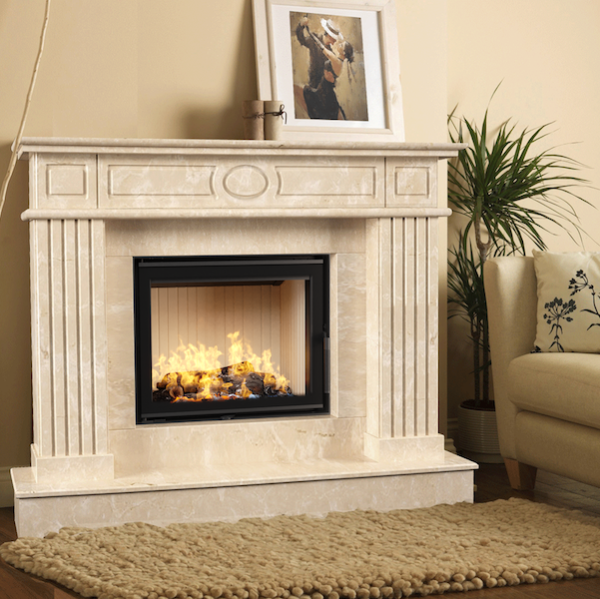
The decision to buy a fireplace to heat the house can be taken quickly and on impulse, but when it comes to actually choosing one, the buyer faces a whole set of questions: an insert or a stove? Closed or open? Wood-burning or pellet? With a water jacket or without? And which fireplace insert to buy — steel or cast iron?
In this article we look in more detail at the advantages of steel inserts. Metal inserts made of fire-resistant steel have in recent years become the most popular choice among buyers, so it is worth setting out exactly why steel fireplace inserts have won everyone over.

What is a wood-burning steel insert made of?
A modern steel insert is not only a living fire, the crackle of wood and an ornament for the interior; it is also quality, powerful heating of the room with economical fuel use thanks to a long-burning system. Wood-burning steel inserts have even partly pushed their competitor — the cast iron insert — out of the market, and all because steel is cheaper, conducts heat better and looks considerably more attractive and refined than heavy black cast iron.
A soft and workable material made it possible to design steel fireplace inserts in non-standard shapes and sizes, and the ability of steel to heat up instantly and give off heat turned steel fireplaces into a genuine trend in heating equipment.
Many people mistakenly believe that steel is a worse material for fireplace inserts than cast iron: it heats up quickly and cools quickly, and is less resistant to high temperatures. But a steel insert is not made from an ordinary sheet of metal. Its manufacture uses strong, heat-resistant alloyed boiler steel; depending on the thermal load on the particular part, the thickness is from 3 to 5 mm.
Steel is an alloy of iron with carbon (from 0.02 to 2.14% carbon) and impurities (silicon, manganese, sulphur, phosphorus and gases). In order for a steel insert or stove to withstand large temperature swings, the steel for the bodies is smelted using a special technology. Whether the insert turns out heat resistant and durable depends precisely on the quality of that smelting and the uniformity of the material.
To improve the quality of the steel, the content of harmful impurities in the alloy is reduced, while alloying additives (from the Latin ligare, "to bind") are used to increase uniformity: they reduce grain size and improve the thermal stability of the material.
| chromium | (Cr) | increases hardness and strength, improves corrosion resistance |
| nickel | (Ni) | improves corrosion resistance, increases strength and ductility |
| molybdenum | (Mo) | increases elasticity, anti-corrosion properties and resistance to oxidation at high temperatures |
| tungsten | (W) | prevents grain growth on heating and helps eliminate brittleness |
| vanadium | (V) | increases hardness and strength, raises the density of the steel |
| titanium | (Ti) | increases the strength and density of the steel, improves corrosion resistance |
| aluminium | (Al) | increases the heat resistance of the steel |
| copper | (Cu) | improves corrosion resistance |
If alloying elements are added to steel in insignificant quantities (less than 0.1%), such an alloy is called low-alloy steel. In most cases it is exactly this type of steel that is used. Steel in which the proportion of alloying elements is 10-15% or more is called high-alloy steel.
The combustion chamber of steel inserts is fitted with thick protective panels of materials such as fireclay, vermiculite, keramot, nerolit and so on. They protect the chamber from overheating and deformation.
Steel fireplace inserts undergo anti-corrosion treatment, after which they are coated with heat-resistant paint. This extends their service life and protects their appearance from the effects of high temperatures.
What are the advantages of a steel insert for a fireplace?
A wood-burning steel insert is the foundation of a warm house and a comfortable interior. A steel fireplace insert has a whole set of advantages: from energy efficiency and output to an accessible price and a great many design options.
High efficiency and heat output
Low- and high-alloy steels have high heat resistance and heat conductivity. Since steel melts at a temperature 20% higher than the temperature at which cast iron melts, its heat resistance is accordingly also considerably higher.
That property allows steel inserts and stoves to move heat from the body of the appliance into the room faster. A steel insert body can transfer heat 50% more effectively than cast iron.
The drawback of steel's rapid cooling was solved by the designers by lining the inner part with fireclay — a special heat-resistant clay. Fired fireclay blocks have 38% more heat capacity than grey cast iron or ordinary steel.
Fireclay can withstand temperatures up to +1200°C and — importantly — has increased resistance to temperature swings. Another of its advantages is that fireclay absorbs heat and holds it inside for a long period, which extends the heat output of the insert. Once it reaches its highest heat capacity, the material begins to reflect heat back, raising the combustion temperature and with it the efficiency with which fuel burns in the chamber.
Thanks to the fireclay lining, steel fireplace inserts hold heat for 5-6 hours.
The safety of steel inserts
The steel body of the insert is welded with sealed seams. That is more reliable than cast iron constructions sealed with sealant, which need replacing over time. There are also models of steel insert with a double body, where the inner one is designed to protect against possible deformation and the outer one provides the sealing.
An automatic combustion control system can be fitted to any steel fireplace insert. The automatic combustion management system registers the current phase of the burning process and controls the precise air supply, in order to obtain as much energy as possible from the wood being burnt.
Steel fireplace inserts are designed so that service access is located inside the body of the fireplace, which allows all the important parts inside the combustion chamber to be serviced fully. There is no need for additional inspection openings.
Steel inserts with doors have heat-resistant glass with a system that keeps it clear of soot, which prevents fire or sparks entering the room while still allowing you to enjoy the sight of the flame.
Modern steel fireplace inserts are designed taking into account all the requirements of the European regulations that set standards for combustion efficiency and the environmental safety of metal fireplaces.
A varied model range of steel fireplaces
Another advantage of steel is its plasticity. That allows a wide variety of modern steel fireplace inserts to be designed and does not restrict the manufacturer in matters of design. As a result every buyer has the chance to buy a steel fireplace that takes account of their needs and of how harmoniously it will fit into the interior of the house.
Steel can be painted in different colours, engraved, or given a beautiful surround for the insert. A steel fireplace can be large or small and come in the most varied shapes.
Steel fireplace inserts come:
- with a single (front) pane
- corner (with glass on two sides)
- three-sided (with glass on three sides)
- tunnel inserts (for installation in a wall at the junction of two rooms)
By the way they open, the doors of a steel insert may be:
- side-opening
- with a guillotine (vertical opening)
- combined — with both side and guillotine opening (in some tunnel inserts)
Simple installation and care
The compact dimensions and weight of steel inserts allow them to be installed almost anywhere convenient. A steel insert can also be fitted at any stage of a renovation. The work will take just one or two days, which is at least 3-4 times faster than installing a cast iron fireplace.
To remove soot from the walls of the firebox, it should be treated with special chemical preparations.
The glass in wood-burning inserts, however, is equipped with a self-cleaning system. Air is fed into the firebox from top to bottom and burns. As it enters the combustion chamber of the fireplace it washes over the glass and is used in the burning process, then leaves through the chimney. So there is no need to clean the glass separately in inserts with this option, which is very convenient.
The price of a steel insert for a fireplace
The price of a steel insert is one of its main competitive advantages. The price of steel fireplace inserts differs substantially from the cost of cast iron ones. Steel is simpler to work with in production and, accordingly, cheaper. So buying a steel insert inexpensively is considerably easier than buying a cast iron one. For prices on specific models, please check with a manager or a representative in your region.
So, to sum up. The main advantages of steel inserts are:
- A high efficiency figure
- Resistance to temperature swings
- Energy efficiency
- A large heated area
- A high rate of heating
- A varied model range
- Simple installation and care
- Safe operation
- An accessible price
Find all SAVEN steel insert models at these links:
Straight SAVEN steel inserts
Corner SAVEN steel inserts
► Read more about what SAVEN inserts are made of in the article Advantages of SAVEN steel fireplace inserts
► Read more about the rules for fitting an insert in the article Requirements for installing a fireplace insert