

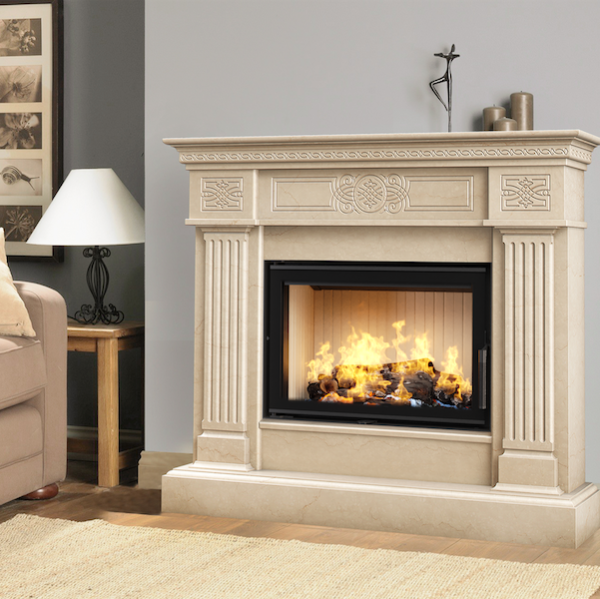
As autumn and winter arrive, people take an increasingly active interest in buying a fireplace for the home. It is convenient, economical, practical and beautiful. Yet many are held back from the final decision to install a wood-burning fireplace at home by fear — fear that it might be risky, that the house could catch fire, that the family inside would be in danger.
This is one of the most common fears among people thinking about installing fireplace heating. And it is an entirely normal feeling: we all care about the safety of ourselves and our families, and here we are dealing with fire that burns openly. More precisely, it burns behind a door fitted with heat-resistant glass, in a firebox that is reliably sealed.
In this article we explain why that fear is largely unfounded, and why modern wood-burning fireplaces are both safe and efficient.
Is it safe to install a wood-burning fireplace at home?
Modern wood-burning fireplace inserts are refined constructions that bear only a distant resemblance to the old open fireplaces of the past, where nothing separated the fire from the room. The main rule for every manufacturer of modern fireplaces is safety. The construction of a solid-fuel fireplace must be airtight, tight-fitting and strong.
Wood-burning fireplaces today are hermetically closed combustion chambers fitted with doors of heat-resistant glass and metal. The steel body is welded with sealed seams. For additional safety, all openings, spigots and other elements of the insert are sealed with special graphite fireplace cords that withstand high temperatures.
A modern fireplace insert also means a system of secondary combustion of gases and the option of drawing combustion air from outside rather than from the room, which improves how the fireplace works, increases its efficiency and keeps harmful fumes out of the indoor air.
These characteristics make it fair to say that a wood-burning fireplace is entirely safe and can be installed at home without fear as a full heat source. And to make using it as safe as its construction, we recommend following the rules below.
.jpeg)
How do you use a wood-burning fireplace safely?
To make using a wood-burning fireplace as safe as possible, remove flammable materials from around the fireplace and follow a few simple rules:
- Carry out the installation according to the technical requirements for fitting a fireplace insert — see the article on preparation for installing a fireplace insert.
- Inspect and clean the flue periodically. There is a checklist in the article how safe is your chimney.
- Use the fireplace according to the manual, and never put the fire out with water.
- Buy SAVEN inserts and stoves from certified dealers — see the "Where to buy" section on our website.
What actually causes fires involving fireplaces?
Statistically it is almost never the appliance itself. The usual causes are a flue that has not been swept, where accumulated soot ignites; combustible materials left too close to the firebox; a flue passing through a wooden floor structure without proper insulation; and ash emptied into a plastic bucket while embers were still smouldering inside it.
Every one of these is a maintenance issue, not a design flaw — which is precisely why the four rules above matter more than any specification in the data sheet.
Follow the recommendations, and let fireplace heating bring warmth and comfort to your home. You can see the range in the straight inserts, corner inserts and steel fireplace stoves sections.
SAVEN — Ukrainian manufacturing, European quality!
READ ALSO: