

Before and during the heating season you should be certain that the chimney is sound. Not only the proper working of a wood-burning fireplace or stove depends on it, but also the safety of the house and the people in it.
In this article we cover the basic rules for looking after a chimney and advice on how to avoid faults, blockages and fires.
A test to determine whether your chimney is safe
Answer "yes" or "no" to the following questions:
| YES | NO | |
| Was your chimney fitted by a qualified team in accordance with all the standards? | ||
| Have you had a professional chimney inspection within the past year? | ||
| Was the chimney swept before the last heating season? | ||
| Is the chimney free of visible damage on the outside? | ||
| Does the roof covering fit tightly against the chimney? | ||
| Is the top of the chimney free of foreign objects (branches, animal nests)? | ||
| Do you use good-quality dry firewood and purpose-made firelighters? |
If you answered "yes" to every question — congratulations, your chimney is safe. If there is any point you are unsure about, read on.
How do you tell whether a chimney is safe?
If your fireplace and chimney are not cleaned regularly, ash, soot and other tar and creosote deposits can cause a chimney fire. As a homeowner you should always know the condition of your chimney.
The first step is to check that the chimney cap is sound. The cap prevents birds, animals, rain and snow from entering the flue, and also acts as a filter that keeps soot off your roof. It is best checked directly on the roof, but if you cannot get up there, use binoculars. Check that the cap is clean, free of debris and undamaged.
It is better to have this check done not by yourself but by a specialist who will carry out a professional chimney inspection.
Here are several other signs that the safety of the chimney meets the requirements:
- No debris accumulates on the chimney.
- There is no bird's or animal's nest at the top of the chimney.
- There are no tree branches next to or above the chimney.
- There is no crumbling or missing mortar and brickwork (if you have a masonry chimney).
- The height of the flue is at least 5-7 m from the surface where the fuel burns.
- The chimney above the roof is no lower than the ridge, and preferably 0.5 m higher or more.
- The chimney is 1.5 m or more from the roof ridge horizontally.
- The roof covering fits tightly against the chimney.
- Where the flue passes through timber structures and other combustible elements, it is insulated.
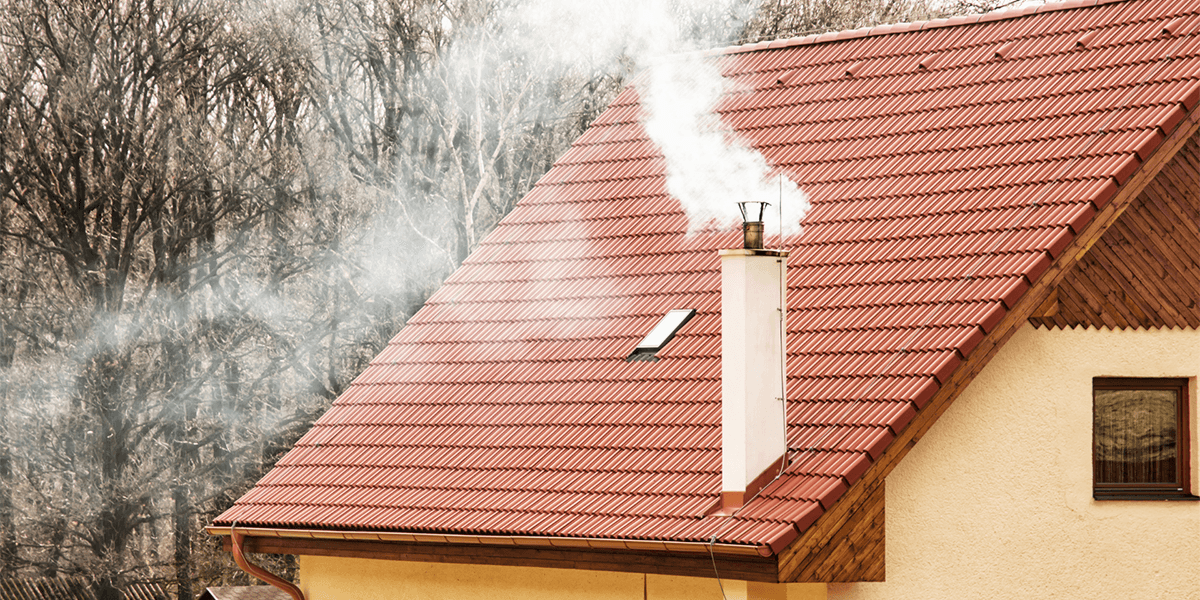
What to check before the season: a step-by-step checklist
So that nothing is forgotten, go through this list before the first fire — it gathers everything covered in this article:
- Inspect the top of the chimney and the cap. The cap must be intact and clean, free of debris. It is what keeps out birds, animals, rain and snow. If you cannot get onto the roof, inspect it from below with binoculars.
- Make sure there are no foreign objects on or around the flue. Birds' or animals' nests, blown debris, tree branches above the chimney — all of these restrict the draught and must be removed.
- Check the external condition of the flue. Visible damage is unacceptable; on a masonry chimney look separately for crumbling or missing mortar and bricks.
- Look at where it passes through the roof. The roof must fit tightly against the chimney, with no gaps or leaks.
- Check the insulation where it passes through the structure. Wherever the flue crosses timber structures and other combustible elements, insulation is mandatory.
- Verify the geometry of the chimney. The flue height is at least 5-7 m from the burning surface; above the roof — no lower than the ridge, preferably 0.5 m higher; horizontally — 1.5 m or more from the ridge.
- Sweep the chimney. Cleaning is carried out at least once per heating season, and inspection through the access doors at least once a month.
- Book a professional inspection. Once a year the chimney and the appliance should be checked by a specialist, inside and out.
- Prepare the fuel. The wood must be well seasoned (ideally at least 6 months) and no larger than the firebox. No rubbish, boards, sawdust, coal or Christmas trees.
- Clear the area around the fireplace. Furniture and anything that can catch fire must be at least 50 cm away.
If the inspection shows that some element of the flue is deformed, burnt through or does not fit together properly, it is not "repaired with whatever is to hand" — it is replaced with a part of the same system. Pipes, elbows, tees, inspection doors and fixings are gathered in the CHIMNEYS section; for the price of a specific part, please check with a manager or a representative in your region.
Practical advice on chimney safety
Now that you know the basic chimney safety requirements, here are the most important rules for looking after the fireplace area and the flue:
1. Book an annual chimney safety inspection
Even if you take every precaution, check the chimney yourself and follow the rules of use, it is still better to call in professionals. Arrange an annual safety inspection and ask the specialists to check the fireplace or stove and the chimney to be sure there are no faults, inside or out.
2. What firewood should you burn?
For lighting and burning in a fireplace or stove, use well-seasoned wood of deciduous or fruit species (ideally seasoned for no less than 6 months). You must not use wood larger than the firebox, foreign objects, boards, rubbish, Christmas trees, sawdust or coal.
3. Do not use prohibited firelighters
To ensure maximum chimney safety, never light the fire with chemicals or liquids such as petrol or engine oil. Such fuel starters can leave harmful residues that may ignite and cause a chimney fire. Use only firelighters intended for fireplaces and wood stoves.
4. How often should a chimney be swept?
How often the chimney needs cleaning depends on how quickly it is fouled by combustion products. It is recommended to sweep the chimney at least once per heating season. Inspection through the access doors for deposits should be carried out at least once a month.
This is exactly why an inspection door and a condensate element are designed into the system at the specification stage: without them access to the flue is closed, and cleaning turns into dismantling the pipe. Such elements are available in the chimneys section.
5. Keep the fireplace area clean
Chimney safety is not only about making sure the fireplace and flue are in good condition, but also about the space around the fireplace being safe. Keep furniture and any items that could catch fire at least 50 cm from the fireplace.
When is a chimney no longer worth repairing?
If the flue has damage right through it, is deformed by overheating, has lost the tightness of its joints, or its elements have been "assembled" from parts of different systems and do not hold together — it is safer to replace the section or the whole run than to prolong its life artificially. The same applies when, after a chimney fire, a specialist has not confirmed that it is fit for further use. Choose new elements in the chimneys section, and if you are replacing the appliance along with the flue, look at the fireplaces and stoves section.
What firewood is best for a fireplace and stove
Top 3 problems in the operation of the fireplace and their solutions