

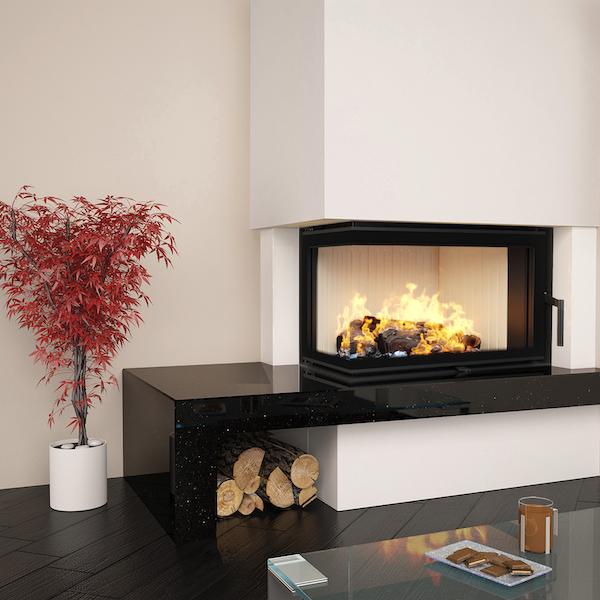
Wood-burning steel inserts have become very popular with buyers in recent years. There are several reasons: they are more powerful, more modern, and the steel range offers a wider choice of sizes and models, and many more possibilities for the interior you have in mind.
The reason for all these advantages of steel wood-burning inserts lies in the material they are made of. In this article we look in more detail at exactly what steel fireplace inserts are made from.
What are steel fireplace inserts made of?
Obviously, steel fireplace inserts are made of steel. But the technology is more complex than it sounds, because the appliance is not simply cut from an ordinary sheet of metal.

Steel is an alloy of iron and carbon (from 0.02 to 2.14% carbon) together with impurities — silicon, manganese, sulphur, phosphorus and gases.
The body of the insert is made of strong, heat-resistant low-alloy boiler steel 3 to 5 mm thick, smelted to a special process. Whether the insert turns out heat-resistant and durable depends precisely on the quality of that smelting and the uniformity of the material. To improve the quality of the steel, the content of harmful impurities is reduced, and to increase uniformity alloying additives are used (from the Latin ligare, "to bind"), which reduce the grain size and improve thermal stability:
- chromium (Cr)
- nickel (Ni)
- molybdenum (Mo)
- tungsten (W)
- vanadium (V)
- titanium (Ti)
- aluminium (Al)
- copper (Cu)
If alloying elements are added to steel in small quantities, the alloy is called low-alloy steel. In most cases it is exactly this type of steel that is used for manufacturing steel fireplace inserts. High-alloy steel is steel in which the share of alloying elements reaches 10–15% and above.
Why is the thickness of the steel not the only thing that matters?
A thicker sheet does give a more rigid body, but on its own it does not protect the appliance. What protects the steel from burning out is the fireclay lining of the combustion chamber, which takes the direct heat of the flame, and the design of the airflow, which keeps the temperature within the working range.
That is why a well-designed insert with 3–4 mm walls and a proper 35 mm fireclay lining will outlast a thicker but unlined one. The thickness matters most where the steel is exposed — the smoke collector, the deflector, the body panels.
What else is a fireplace insert made of?
Besides the steel body there are four more components that determine how the appliance behaves: heat-resistant Schott Robax glass in the door, the fireclay boards lining the chamber, the sealing cords that keep the chamber airtight, and the double deflector that lengthens the path of the flue gases and returns more heat to the room.
The advantage of Ukrainian SAVEN steel inserts is full compliance with Ecodesign requirements. Safe and environmentally clean materials, energy efficiency and affordability, stylish design and ease of use are far from the only benefits of this type of equipment. You can see the range in the straight inserts, corner inserts and Energy Up with a guillotine door sections.
READ ALSO:
WHAT GLASS IS USED IN SAVEN STEEL FIREPLACE INSERTS AND STOVES