

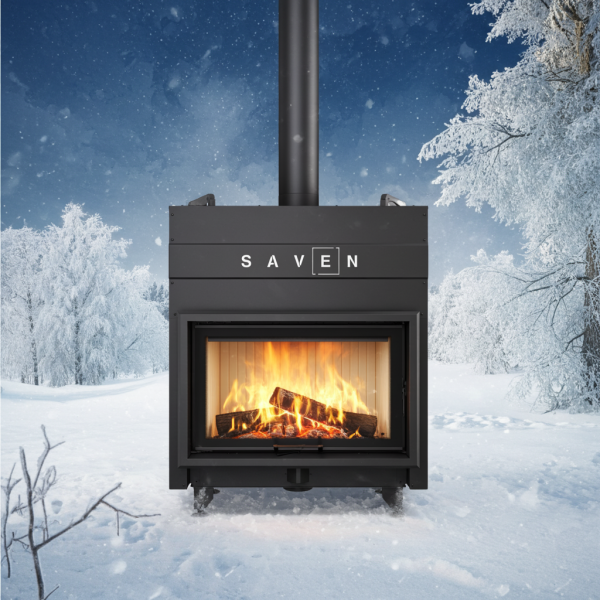
Severe frost is a real test for any heating system. When temperatures drop to -20 °C and below, and electricity or gas supply becomes unstable, a steel wood-burning fireplace is often considered as backup heating in winter or even as fully autonomous fireplace heating.
But can it really heat a house in such cold conditions? And how should it be used properly to avoid disappointment?
This article provides a honest, non-marketing analysis of the capabilities of a steel fireplace, a step-by-step guide to operation in freezing weather, and common mistakes that reduce efficiency to zero.
Is it really possible to heat a house with a steel fireplace at -20°C?
Let’s start with the main question that concerns most homeowners.
Does a fireplace heat effectively in winter during severe frost?
Short answer: yes. Fireplace heating in freezing weather is possible if three key conditions are met:
- the fireplace is correctly selected according to its output power;
- the ventilation and convection system works properly;
- the fireplace is operated in the correct mode.
A steel fireplace is not a full replacement for a boiler in a large house, but it:
- effectively heats the main living areas;
- maintains a positive temperature throughout the house;
- provides heat during emergency outages.
The limits of steel: no illusions
It is important to understand the physics of the process:
- steel heats up quickly but also releases heat quickly, which is why all SAVEN fireboxes are lined with chamotte that accumulates heat and retains it for a longer time;
- without continuous refueling with firewood, the temperature drops faster;
- at -20°C, a house’s heat loss increases by 1.5–2 times.
Therefore, the answer to the question does a fireplace heat in winter is as follows:
- as an additional or backup heat source — yes;
- as the only heat source for a large house — with limitations;
- as a “load it once and forget it” solution — no.

A steel fireplace without electricity and gas: what to consider
In crisis scenarios, a fireplace often becomes the only source of heat.
Advantages of a fireplace as an autonomous solution
A fireplace without electricity has several important advantages:
- operates without connection to power grids;
- does not depend on gas supply;
- creates stable local heat.
That is why a steel fireplace is often used as autonomous fireplace heating in private homes.
How to properly operate a steel fireplace in severe frost
This is a key section, as improper firing of a fireplace eliminates all its advantages.
Step-by-step guide: firing a fireplace in freezing weather
Step 1. Fireplace preparation
Before lighting, check:
- chimney cleanliness;
- that ventilation grilles are open;
- that the air supply is not blocked.
Without this, operating a steel fireplace in freezing temperatures will be problematic.
Step 2. Ignition — no sudden loads
In extreme cold, you must not load the firebox fully right away.
Correct approach:
- a small load of dry firewood;
- preheating the chimney;
- only after stable draft — the main fuel load.
This reduces the risk of smoke spillage and thermal deformation.
Step 3. Main combustion mode
How to heat a fireplace in winter correctly:
- use hardwood firewood;
- maintain stable rather than “aggressive” combustion;
- do not abruptly shut off the air supply;
- operate longer in a medium mode rather than in short high-intensity peaks.
Step 4. Pauses between firing
A steel fireplace does not tolerate long temperature “drops.”
Optimal approach:
- take short pauses;
- maintain minimal embers;
- avoid complete cooling of the body.
Which firewood is critical at -20°C
In freezing conditions, firewood choice directly affects efficiency.
Best options include:
- oak;
- beech;
- hornbeam;
- ash.
Avoid:
- wet firewood;
- softwood as the main fuel (burns too quickly);
- questionable wood waste.
Common mistakes when operating in severe frost
Mistake 1: “Let’s give it maximum — it will be warmer”
Excessive firing:
- does not increase efficiency;
- overloads the metal;
- shortens the fireplace’s service life.
Mistake 2: Blocking ventilation
Closed grilles:
- cause overheating;
- impair convection;
- reduce heating efficiency.
Mistake 3: Incorrect firewood selection
Wet firewood in freezing conditions:
- lowers combustion temperature;
- worsens draft;
- increases soot formation.
Conclusion: an honest view of a steel fireplace in freezing weather
Let’s summarize without embellishment:
A fireplace at -20 degrees is a realistic scenario with a competent approach;
Fireplace heating in frost works best as part of a system;
A fireplace without electricity is a reliable option in crisis conditions;
proper operation of a steel fireplace determines the result by 70%.
With proper firing, high-quality firewood, and realistic expectations, a steel fireplace can deliver the most important things — warmth, safety, and autonomy, even when it is -20 °C or colder outside.