

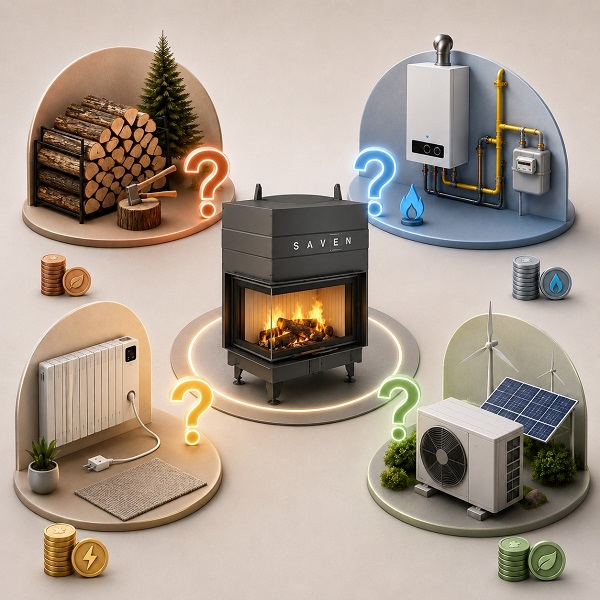
All prices, tariffs and calculations in this article refer to the Ukrainian market.
The main principle of our company is saving energy. And we always point out that heating a house with a fireplace is the best way to accumulate that energy, keep it and direct it where it belongs — into warming your home.
But a fireplace costs money, so before investing in fireplace heating a prospective buyer wants to work out how worthwhile it is and how quickly the investment pays for itself.
When it comes to price, the numbers should do the talking. Below is a current comparison of the three usual options — gas, electricity and firewood — together with the method you can use to repeat the calculation for your own country and your own supplier.
How should the cost of different fuels be compared?
Comparing fuels "per cubic metre" or "per kilogram" is misleading: different fuels release different amounts of heat, and different appliances burn them with different efficiency. The only correct figure to compare is the cost of one kilowatt-hour of heat that actually reaches the room.
The formula is simple:
cost per kWh of heat = fuel price ÷ (calorific value × efficiency)
Where the calorific value is how much energy a unit of fuel contains, and the efficiency is the share of that energy the appliance actually delivers to the room rather than sending up the chimney. Substitute your local prices and you will get a figure you can compare directly.
What does the comparison look like in practice?
Below is a worked example using Ukrainian prices as of July 2026. The absolute figures will differ in your country, but the proportions and the method stay the same.
| Fuel | Price | Calorific value | Efficiency | Cost of 1 kWh of heat |
|---|---|---|---|---|
| Hardwood firewood (official price) | 1,400 UAH/m³ | 2,900 kWh/m³ | 80% | 0.60 UAH |
| Hardwood firewood (open market) | 1,800–3,000 UAH/m³ | 2,900 kWh/m³ | 80% | 0.78–1.29 UAH |
| Softwood (pine, alder) | 1,100 UAH/m³ | 1,550 kWh/m³ | 80% | 0.89 UAH |
| Natural gas | 7.96 UAH/m³ + delivery | 9.5 kWh/m³ | 90% | 0.93–1.28 UAH |
| Electricity (day) | 4.32 UAH/kWh | — | 99% | 4.36 UAH |
| Electricity (night, two-zone meter) | 2.16 UAH/kWh | — | 99% | 2.18 UAH |
Conclusion. Hardwood firewood at the official price is the cheapest heat available today: roughly 30–40% cheaper than gas and six to seven times cheaper than daytime electricity. But that advantage disappears as soon as you buy firewood on the open market: at 2,500–3,000 UAH per cubic metre firewood already costs about the same as gas.
Why has the picture changed since 2022?
For comparison: in June 2022 the same calculation gave roughly 1.22 UAH per kWh for gas, 1.44 UAH for electricity and 0.77–0.86 UAH for firewood. Since then all fuels have risen in price, but not equally — electricity has risen the most, which is why the gap in favour of firewood has widened rather than narrowed.
Watch the unit of measurement
Official prices are quoted per solid cubic metre, while advertisements often quote a stacked cubic metre — a stack of split logs that contains only about 0.7 of a solid cubic metre of wood. So the same number in an advertisement can mean a price roughly 40% higher. Always check which unit the seller means before comparing offers.
Moisture decides the outcome
Freshly cut wood contains 40–50% water, and part of the heat is spent evaporating it instead of warming the room. Wood seasoned to 15–20% moisture gives roughly a third more heat from the same volume. Hardwoods (oak, hornbeam, beech, acacia) yield 2,800–3,000 kWh per cubic metre, softwoods (pine, alder, poplar) only 1,450–1,600.
This is why a cheap cubic metre of damp wood is often more expensive in practice than a dearer cubic metre of properly seasoned wood — you are paying to boil off water.
What else affects the real cost of heating?
How much heat you actually get depends on the equipment as well. An old open hearth sends most of its heat straight up the chimney, while a modern closed insert returns it to the room. So the efficiency figure in the table is not an abstraction — it is the difference between paying for heat and paying for smoke.
- for the fireplace to warm the whole house, the insert must be correctly matched to the floor area and output, and the heat distributed between rooms through ventilation grilles;
- the chimney must be correctly sized: with a weak draught the appliance will not reach its rated efficiency;
- and the firewood must be dry — see the point above.
You can choose a model in the straight steel inserts, inserts with a guillotine door and steel fireplace stoves sections; among cast iron models there are KAWMET inserts and stoves and MORSO stoves.
How much firewood does a house need for one season?
Once you know the cost per kilowatt-hour, the next practical question is how many kilowatt-hours you will actually burn. The rough sequence is:
- Estimate the heat demand. As a starting point, a reasonably insulated house needs about 1 kW of output per 10 m² of floor area. For a 120 m² house that is roughly 12 kW.
- Convert output into seasonal energy. A fireplace does not run at full output around the clock. In practice, over a heating season of about six months, a house of that size consumes on the order of 10,000–15,000 kWh of heat, depending on the climate and the insulation.
- Convert energy into cubic metres. Dividing by the useful yield of hardwood (about 2,900 kWh per solid cubic metre × 80% efficiency ≈ 2,320 kWh) gives roughly 4–6.5 solid cubic metres of seasoned hardwood for the season.
These are order-of-magnitude figures, not a design calculation. But they are enough to compare a season of firewood against a season of gas or electricity in your own prices — and to plan storage space, because those cubic metres have to be kept dry somewhere.
How long does a fireplace take to pay for itself?
The payback period is the difference in annual running costs divided by the total investment. The investment is not only the appliance: it also includes the chimney, the grilles, the surround and the installation.
Two things are worth keeping in mind when you do that sum. First, a fireplace rarely replaces the existing system entirely — more often it takes over part of the load, so the saving is a share of the bill rather than all of it. Second, the payback is not the whole point: independence from gas and electricity supply has a value of its own, and it is the reason many households install a fireplace even when the arithmetic is close to neutral.
Which is cheaper: gas, electricity or firewood?
On the figures above, firewood at the official price wins clearly, gas comes second, and electricity is by far the most expensive way of producing heat — unless you have a two-zone meter and can shift most of the load to the night tariff, which halves the cost but still leaves electricity behind the other two.
But the ranking is not fixed. It flips as soon as any of three things change: the price you actually pay for firewood, how dry that firewood is, and the efficiency of the appliance burning it. That is exactly why it is worth recalculating with your own numbers rather than trusting a general statement that "wood is cheaper".
In the end everyone chooses the heating option that suits them best. But if you do settle on fireplace heating, we strongly recommend consulting specialists. An incorrectly selected and installed fireplace will not give the effect you expect, whereas a professional will choose an insert of the right size and output, select the components and distribute the heat throughout the house — leaving you with a warm, comfortable home and minimal heating costs.
Price sources: Naftogaz of Ukraine, the National Energy and Utilities Regulatory Commission, the state enterprise Lisy Ukrainy and the DrovaYe portal, plus market listings, July 2026. The cost per kWh is a calculated value with an error margin of ±15–20% depending on the moisture content of the wood and the real efficiency of the appliance.