

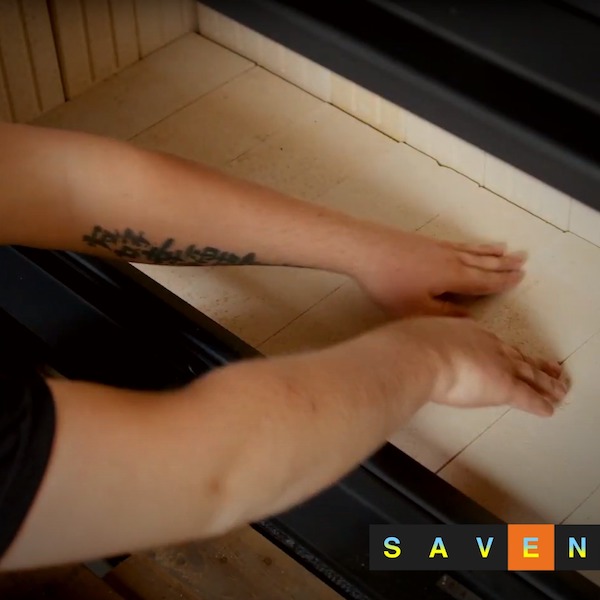
Buying a steel insert is only half the journey towards the fireplace you want at home. The next and most important step is installing it. SAVEN strongly recommends that fireplace installation be carried out by a specialist with the right tools and knowledge. Only a professional can correctly fit a steel insert, connect the fireplace to the flue, check the whole construction and carry out a test firing.
Installing a steel insert is important, responsible work that must be done stage by stage and in compliance with all the rules. That is what guarantees safe and efficient use of the fireplace for many years.
Installing a steel fireplace insert: rules and recommendations
Only a specialist knows how to fit a fireplace insert properly. They will advise where exactly to place it, which fireplace components to buy, and will carry out the work step by step, safely and to a high standard. In this article we set out the main rules of steel insert installation, so that you understand the process and know what to expect.
How do you prepare for installation?
Before starting the installation of a wood-burning fireplace, you need to prepare thoroughly: buy the components, check that the flue is sound, and prepare the place where the fireplace will stand.
A fireplace with a closed firebox is an appliance that can cause a fire if used incorrectly, so before installing a solid-fuel fireplace you must take care of the thermal insulation of the walls and floor.
Regulations for installing a wood-burning fireplace
Building regulations differ from country to country, but the logic is broadly the same. In Ukraine, for example, the state building norms permit a solid-fuel fireplace to be designed:
- in an apartment on the top floor of a residential building;
- on any level of a multi-level apartment that is the highest in the building;
- on any level of a single-family house.
For installation in multi-storey buildings, permits from the fire service and the utility company are required. In other countries the list of approvals will differ — always check your local building regulations before you start.
Thermal insulation of the walls
In the place where the steel insert will be installed, the walls must withstand high temperature. It is best if the walls and ceiling are built of brick or stone. In a timber house the wall beside the fireplace will have to be additionally faced with brick or another non-combustible material.
Thermal insulation of the floor
The floor under the insert must also be given maximum insulation and protection. A steel sheet at least 2 mm thick is laid on the floor under the fireplace. As insulating material beneath that sheet, basalt-based wool is used: it is laid between the floor and the structure, because it has high thermal resistance and can withstand up to 900°C.
As a base for a wood-burning fireplace, a non-combustible protective floor covering is chosen. This may be ceramic (for example tiles), a covering of natural stone or other mineral materials (marble, granite), metal 1 mm thick, or glass with the appropriate characteristics. The protective covering must be fixed so that it cannot be moved.
Please note! SAVEN steel inserts have special legs of our own design. The legs simplify installation, so a separate fireplace stand is no longer needed.
Checking the flue
The chimney is placed inside a steel casing and insulated. The connection between the insert and the flue pipe is also carefully insulated.
Before installing the fireplace you must make sure that the flue is airtight, that its draught readings are normal, that it contains no sharp transitions and that its cross-section allows it to be joined to the outlet of the insert.
This is important! Engage only qualified specialists for installing the fireplace and the flue. The specialist carrying out the work bears full responsibility for the draught in the chimney, the supply of outside combustion air and the insulation of the structure.
What are the fire safety requirements?
The place where a solid-fuel fireplace is installed must comply with fire safety rules. You must be sure of the stability of the load-bearing structure, taking into account the weight of the fireplace and its equipment, the weight of the foundation and the cladding elements.
- the combustion chamber of the steel insert must be at least 50 cm from a non-combustible floor;
- the floor in front of the firebox door must be protected with non-combustible material for 30 cm;
- the steel elements of the insert must be at least 60 cm from unprotected combustible parts of the building, and at least 30 cm from parts protected with insulation;
- flue ducts must be made of non-combustible materials;
- the lining of flue ducts must have a fire resistance of at least 60 minutes.
How is a steel fireplace insert installed?
So the place for the fireplace has been chosen and prepared, you have bought all the necessary materials, tools and components, and the installation can begin. The process consists of several stages.
At the first stage a base of heat-resistant brick or aerated concrete blocks is built. A foundation is prepared under the fireplace, at least 5 cm thick.
Next the plinth is laid using several courses of properly shaped brick. After each course the level should be checked.
Before the insert is placed, the masonry must be allowed to dry. Heat-resistant sealant is applied between the body of the insert and the slab. The fireplace must not be pushed tight against the wall. The insert placed on the foundation has to be levelled, and only then connected to the flue and the installation completed.
The final stage is the decorative cladding of the fireplace. Here you can give free rein to your imagination — stone, marble, a ready-made surround, and so on.
What rules apply during use?
- Altering any part of the fireplace insert is prohibited.
- Before lighting a fire, make sure the flue is in good order.
- When servicing the insert, wear personal protective equipment (leather heat-resistant gloves).
- Provide the room with supply and extract ventilation.
- Remove flammable materials from around the insert.
- Do not replace wood with another fuel unless the manufacturer expressly permits it.
- Never use water to put out the fire.
- Installation and connection of a steel wood-burning insert must be carried out by a qualified specialist.