

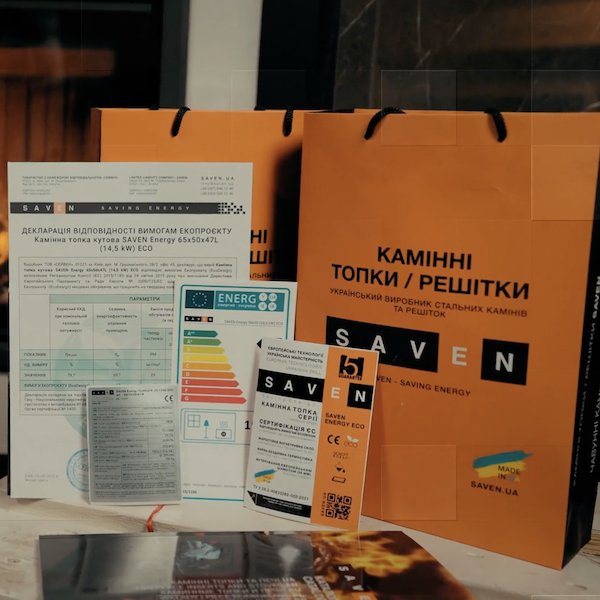
Energy efficiency and environmental performance are important European instruments that allow wood-burning fireplaces and stoves to be as safe as possible for the environment and to save the energy resources of our planet.
Why does this matter so much? Because every inhabitant of our planet should care about the quality of our environment and the preservation of resources for the sake of future generations.
The official regulations on ecodesign and the energy efficiency class that apply in the EU and in Ukraine make it possible to minimise the use of energy resources in the design, manufacture, use and disposal of solid-fuel stoves and fireplaces.
SAVEN, as a manufacturer of fireplace inserts, is convinced that a successful future depends directly on responsibility in the present. That is why we created a product that meets every European directive on environmental performance while also showing high efficiency figures.
The energy efficiency of a wood-burning fireplace
We live in an age of technology and cannot imagine everyday life without various appliances — a refrigerator, a car, or a simple light bulb in a room. At the same time we do not stop to think that the energy resources of the Earth are not inexhaustible, and that human activity has already led to changes on the planet.
Fortunately, people moved to meet nature halfway in time. Developed countries, including those of the EU, adopted a series of directives and laws obliging manufacturers of household appliances to label their equipment. For that, every appliance must pass a series of tests and a procedure for assessing energy efficiency.
What is energy efficiency?
Energy efficiency and economy of energy use describe how effectively an appliance uses energy resources and how far it meets generally accepted rules on saving energy, careful treatment of the environment and the level of pollutant emissions.
Compulsory energy efficiency labelling for most household appliances, industrial equipment, light bulbs and cars was introduced in EU countries in 2010, under European Union Directive 2010/30/EC. Besides the energy efficiency class, the label also contains information about the technical characteristics of the product, depending on its type.
To obtain a label, an appliance must undergo a special independent assessment. Energy efficiency certification consists of the following stages:
- testing;
- analysis of the data obtained;
- the certification decision;
- factory production control;
- issue of permission to use the energy efficiency certification mark.
Labels indicating energy efficiency contain a colour code linked to the classes (from A to G), which gives an idea of the appliance's energy consumption. Class A denotes the highest energy efficiency and G the lowest. This labelling was unified by the European Union and has the same meaning worldwide.
.png)
The energy efficiency label must be present both on the appliance itself and in the product catalogues and on the manufacturer's website.
The energy efficiency class is marked in 7 main classes, from A (the lowest use of resources) to G (the most energy-hungry). Once products reach class A, the additional classes A+, A++ and A+++ are added.
Energy-saving classes such as E, F and G are rarely met with among the characteristics of modern appliances, because of their resource consumption. EU countries, for instance, prohibit the import of products in energy efficiency classes F and G. And without an assigned energy efficiency class it is impossible, under international law, to prove that a product belongs to a class higher than F or G.
How are solid-fuel fireplaces labelled?
Under European law, from 1 January 2021 all domestic appliances burning wood (wood-burning fireplaces and stoves) must carry labelling and meet the requirements for seasonal energy efficiency. In addition, they must not exceed the permitted quantity of pollutant emissions into the air.
The label of a fireplace insert or stove must show the energy efficiency class and other technical data.
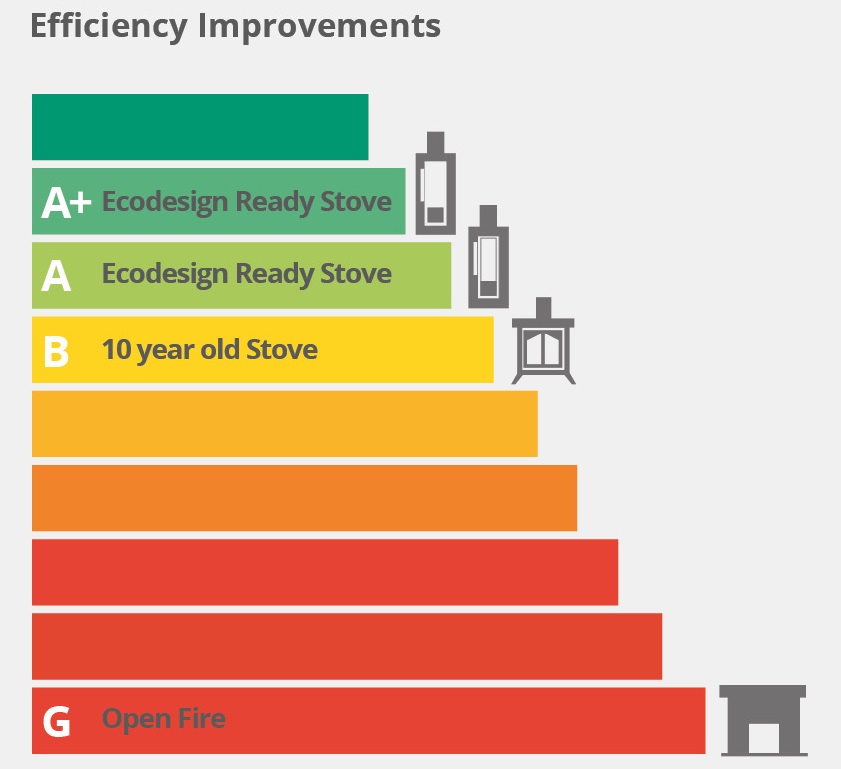
In Ukraine energy efficiency standards are governed by:
- European Union Directive 2010/30/EC;
- Commission Regulation (EU) 2015/1185 of 24 April 2015;
- the Technical Regulation on energy labelling of energy-related products, approved by Resolution of the Cabinet of Ministers of Ukraine No. 702 of 07.08.2013.
The energy efficiency of SAVEN steel inserts
SAVEN Energy steel inserts were tested at the Oil and Gas Institute — the Polish National Research Institute (Instytut Nafty i Gazu — Panstwowy Instytut Badawczy) — where it was demonstrated that all the figures for the inserts meet the requirements of energy efficiency class "A" and "A+".
This is the highest energy efficiency figure, and it means that the SAVEN Energy fireplace insert complies with EU regulations.
.jpg)
Steel fireplace inserts from the Ukrainian manufacturer SAVEN are permitted for use in EU countries, since they comply with Commission Regulation (EU) 2015/1185 of 24 April 2015. Under that document, fireplaces and stoves placed on the market and put into service from 1 January 2022 must meet the requirements for seasonal energy efficiency and pollutant emissions set out in the rules of the EU Commission regulation.
%20ECO.png)
The ecodesign of wood-burning fireplaces
Another important measure for wood-burning fireplaces and stoves is compliance with the requirements of ecodesign. In essence, the ecodesign requirements are a set of rules that determine how environmentally clean and harmless to the environment a product — in this case a solid-fuel fireplace — actually is.
The ecodesign requirements are set out in Directive 2009/125/EC of the European Parliament and of the Council of 21 October 2009. On the basis of that directive, Government Resolution No. 804 of 3 October 2018 came into force in Ukraine, approving the Technical Regulation establishing a framework for setting ecodesign requirements for energy-related products.
What is ecodesign?
Eco Design 2022 is the fireplace industry's answer to the DEFRA clean air strategy (the Department for Environment, Food & Rural Affairs), supported by the EU government in order to improve air quality and reduce pollution and emissions. To that end, Ecodesign sets clear rules for all solid-fuel fireplaces and stoves, in force from 1 January 2022 in the EU and the United Kingdom.
What does the implementation of ecodesign look like in practice, in fireplaces and stoves? Ecodesign in wood-burning fireplaces governs the permitted level of emissions of particulate matter, carbon monoxide, nitrogen oxides and organic gaseous compounds.
Fireplace ecodesign also indicates that the appliance complies with the seasonal space heating energy efficiency required by Commission Regulation (EU) 2015/1185 of 24 April 2015 implementing Directive 2009/125/EC of the European Parliament and of the Council.
The European ecodesign directive begins to apply from 2022. Accordingly, all manufacturers of stoves and fireplaces are obliged to sell environmentally clean products with a minimum content of polluting emissions and maximum energy efficiency.
It should be noted that in other European countries, such as Germany or Austria, strict standards already exist, even stricter than those introduced at EU level from 2022.
Please note! The Eco Design 2022 requirements apply to all fireplaces, fireplace inserts and wood-burning stoves sold and installed after 1 January 2020.
The ecodesign of SAVEN fireplace inserts
The essence of ecodesign is to make the air as clean as possible and to preserve the energy resources of the Earth. So from 2022 all solid-fuel fireplaces must have at least 80% efficiency and meet strict criteria for pollutant emissions, not exceeding the established norm.
In addition, modern wood-burning fireplaces must meet the requirements for seasonal energy efficiency (class A and above).
SAVEN Energy steel inserts have passed independent tests which proved that our inserts meet the requirements of ECODESIGN and BImSchV Stufe 2.
.jpg)
First, SAVEN Energy inserts do not exceed the emission limits for harmful substances (carbon monoxide, nitrogen oxides and organic gaseous compounds).
Second, under ecodesign the seasonal space heating energy efficiency for closed wood-burning fireplace inserts must be no less than 65%. In the SAVEN Energy insert this figure is over 68%.
Third, SAVEN wood-burning inserts have been assigned energy efficiency class A.

What makes SAVEN inserts meet the ecodesign requirements?
Above all, the SAVEN Energy insert is a safe, reliable and carefully thought-out airtight construction, made of quality materials certified in the EU.
The effective flue-gas removal design in SAVEN inserts reduces the release of toxic substances into the environment and lowers fuel consumption.
When a fireplace insert is lit, primary air enters the combustion chamber through special adjustable openings. The smoke, containing fine particles of unburnt fuel, rises towards the chimney and heats the deflector, which slows the rapid combustion process and directs the smoke into the flue. At the same time pre-heated secondary air mixes with the departing gases and secondary combustion takes place.
In SAVEN inserts we fitted a double deflector, which relieves the thermal load on the insert while increasing its energy efficiency.
► Read more about SAVEN Energy inserts in these articles:
Advantages of SAVEN steel fireplace inserts
Modern technologies of SAVEN steel inserts
The models themselves are in the straight steel inserts and corner steel inserts sections.
