

A corner or straight wood-burning fireplace is an excellent alternative to traditional gas heating. First, it means real savings on utility bills; second, it is a way of caring about the environment and natural energy resources. And third, it is energy efficiency: a convection wood fireplace with hot air distributed to adjoining rooms can heat the whole house in a very short time and at a minimal fuel cost. As a bonus you get a wonderful interior feature — a fireplace with a real flame that the whole family will gather around.
Firewood is inexpensive and pays for itself over a heating season. But for it to burn efficiently and give maximum heat, it is important not only to choose it correctly but also to store it correctly.
In this article we will talk about how to store firewood for a fireplace properly, so that it does not become damp or damaged.
.jpg)
How should firewood be stored for a fireplace or stove?
The way firewood is stored plays a key role in whether it will be fit for burning, whether it will end up too damp, and whether it will give out its maximum heat. That is why it is worth following a few basic rules.
The ideal firewood for a fireplace is wood that has been seasoned naturally — that is, kept in a ventilated space or outdoors under a roof for at least six months, including the summer months.
For the wood to dry well and not stay damp, it needs to be split fairly small. The length of the logs should not exceed 30 cm, and the diameter should be around 10–15 cm. Whole rounds are not worth storing — they dry far more slowly.
The split logs should then be stored in a ventilated space or outdoors. Depending on where you keep them, the recommendations differ.
.jpg)
Where should firewood be stored outdoors?
Storing firewood outdoors is the best way of seasoning it naturally. But it is important that the wood stands under cover and dries that way for at least six months, including the summer. Here are a few rules for storing firewood outside:
- Choose a spot on the sunniest side of the house — the wood dries faster where it gets sun and moving air.
- Put up a proper roof or cover to protect the wood from rain and damp.
- Do not stack the logs straight onto the ground, or they will draw up moisture. Put them on a dry base, for example a wooden pallet.
- Stack the wood 5–10 cm away from the wall of the house.
- Leave small gaps between the logs so that air can circulate.
- Never cover firewood with foil, oilcloth or plastic sheeting — condensation forms underneath and the wood stays wet.
If you need to store large quantities of firewood, it is better to build a proper covered log store outdoors that will serve you for years.

How do you store firewood indoors?
If you cannot store firewood outdoors, you can arrange a place for it indoors — in a store room, a shed, or a purpose-built wood store. The main thing is that the space is dry and well ventilated. A cellar, for example, is not a good idea, because humidity there is usually high.
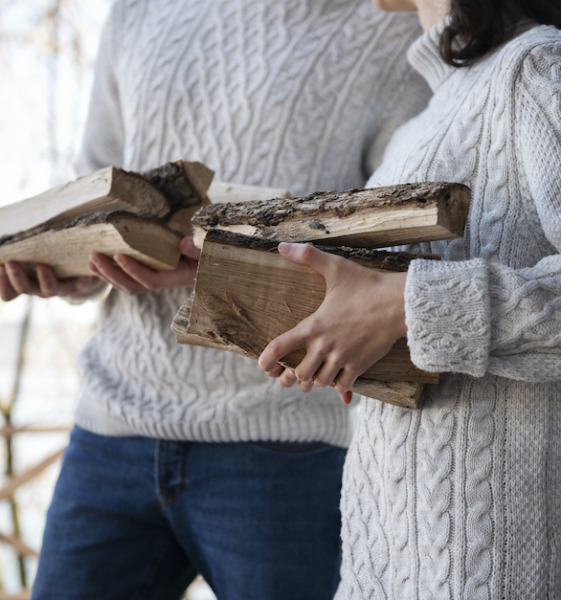
Even if you keep your firewood outside, you always need a portion of wood at hand, stored indoors at room temperature. Small log holders, baskets and stands are best for this — you will find them in the fireplace accessories section.
You can also plan a space for firewood at the fireplace installation stage and build a surround with a niche for it. Then indoor firewood storage becomes not only practical but also a decorative feature.
How do you know the firewood is dry enough?
The target is a moisture content of 15–20%. The most reliable way to check is a moisture meter, but there are simpler signs too: seasoned logs are noticeably lighter than fresh ones, have cracks at the ends, and give a clear ringing sound when knocked together rather than a dull thud.
Why it matters: damp wood spends a large part of its energy evaporating water instead of heating the room. The result is less heat, a sooty glass, and soot building up in the flue — which is why a regularly cleaned chimney and dry firewood always go together.
► READ ALSO: