

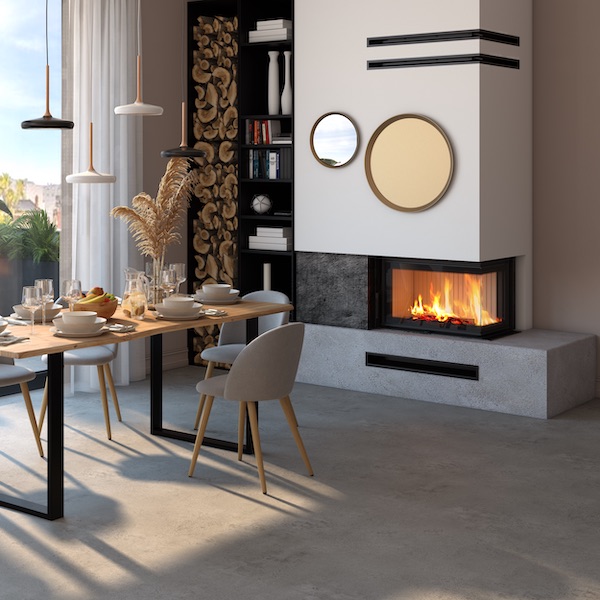
A modern fireplace is the combination of a wood-burning insert and the surround built around it. The overall notion of a "fireplace" also includes the chimney system, the ventilation grilles and the components — that is, everything that together works to heat your home with wood.
In line with European ecodesign and energy efficiency requirements, only closed-type fireplaces of energy class A may be used for heating. Such fireplaces are economical, safe and as gentle on the environment as possible.
By the way they heat a room, closed wood-burning inserts fall into two types:
- inserts for hot-air heating (the convection fireplace);
- inserts with a water jacket (the water fireplace).
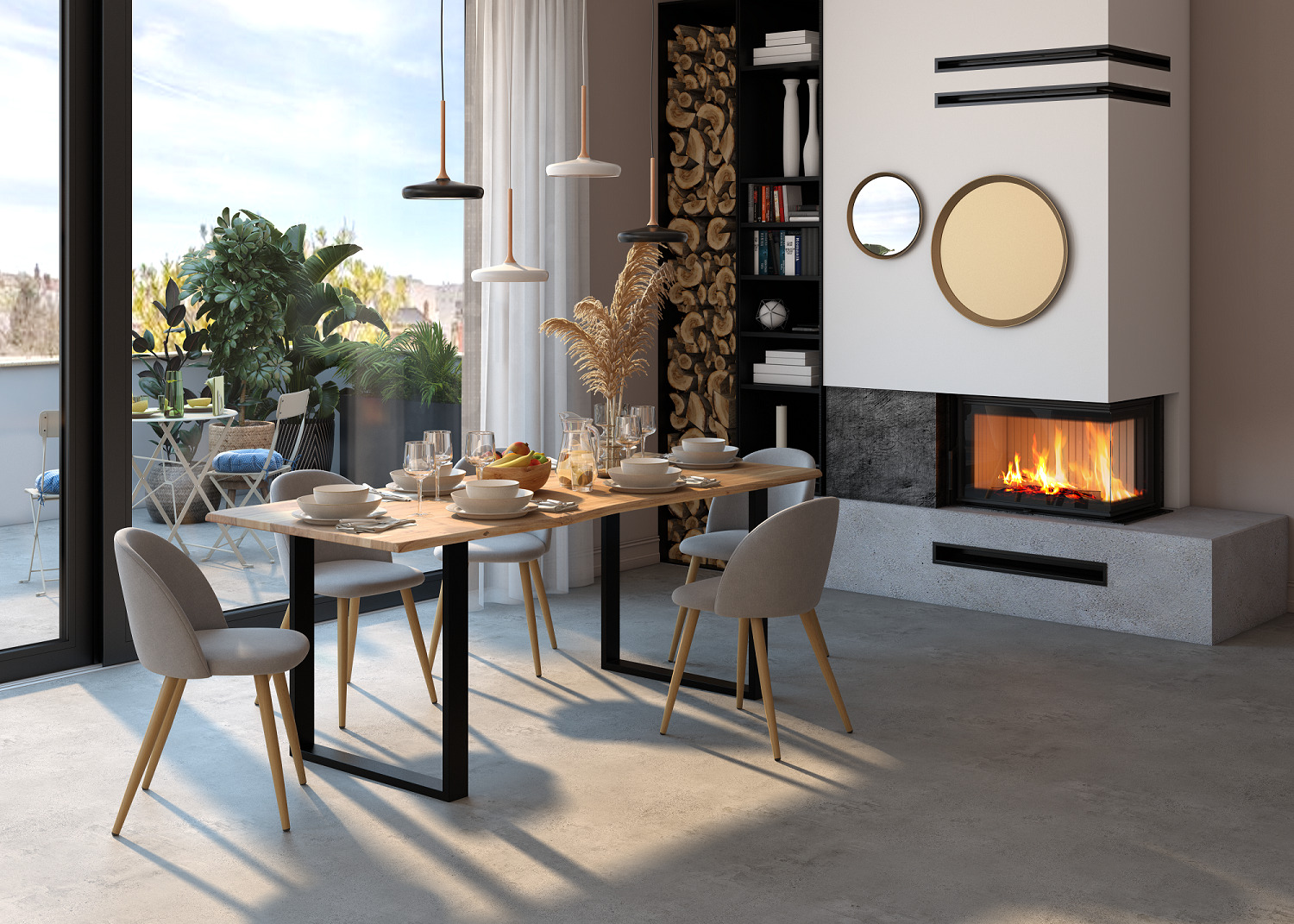
In this article we look in more detail at the first type — the convection wood-burning insert, also called an air insert.
What is an insert for hot-air heating?
Outwardly a convection fireplace looks very much like a traditional open fireplace. But in its technical characteristics an air fireplace is considerably more powerful and safer, and the heating principle is different.
While an open fireplace heats a room naturally — simply by radiating heat from the fire — a closed insert for hot-air heating works in a much more considered way.
The main visual difference of a convection fireplace is the firebox door. The large pane of the combustion chamber, behind which the fire burns, closes the chamber and ensures efficient, economical combustion. The door also protects the room and the people in it from direct contact with the fire, making watching the flame safe.
Having a door is what makes a convection-type fireplace more energy-efficient and more powerful.
How does a convection fireplace work?
To understand how a convection insert works, it helps first to be clear about what convection actually is.
In nature, convection is the transfer of heat in liquids, gases or granular media by movement of the substance itself. In other words, it is when air, water or another substance is heated and carries the heat with it.
Once you understand the principle, it is not hard to see how a convection-type fireplace works. Put simply, it heats air and delivers it into the room.
Like most solid-fuel fireplaces and stoves, a convection-type insert burns wood, and the combustion products leave through the flue. But how exactly does an insert for hot-air heating warm the house?
Through dedicated openings, cool air is drawn either from the room or from outside. It passes between the surround and the insert, is heated while the wood burns in the chamber, and the warm air then leaves through the ventilation grilles into the room.
What is the difference between an air and a water fireplace?
An air fireplace heats the air directly and delivers it to the rooms through ducts and grilles. It warms up quickly, is considerably simpler to install and needs no plumbing. A water fireplace heats a liquid that then circulates through radiators or underfloor heating, so it integrates with an existing central heating system but is more complex and more expensive to fit.
In practice the air version suits most private houses: it starts giving heat within minutes rather than hours, and it keeps working during a power cut, because natural convection needs no pump.
A convection fireplace for heating a house
Today a fireplace for the home has become a real trend, and most buyers are interested precisely in convection fireplaces. Houses are increasingly being fitted with convection-type inserts, whose whole design is built around saving energy.
For air circulation and proper operation of a convection fireplace, houses are fitted with controlled air supply and extract systems as well as a chimney system. The best arrangement is when the hot-air fireplace can draw air not only from the room but also from outside. Then the combustion air comes from outdoors rather than from the room where the fireplace stands.
Advantages of a convection fireplace:
- a safe view of the fire
- high output and efficiency
- the ability to heat adjoining rooms
- fast warm-up
- adjustable heat output
- a wide variety of designs
SAVEN inserts for hot-air heating
The Ukrainian company SAVEN manufactures steel inserts for hot-air heating with straight or corner glass.
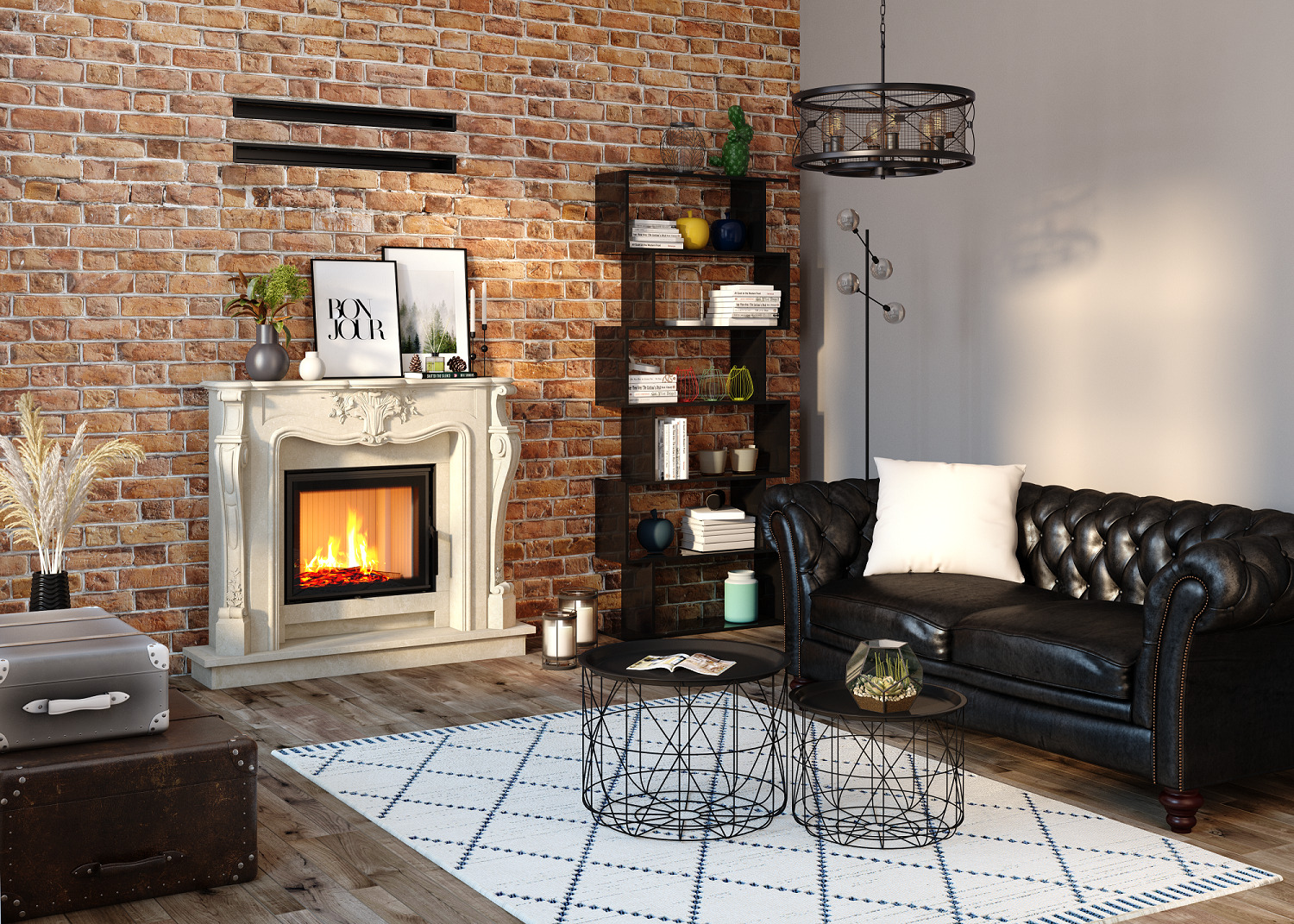
Our inserts work on the convection principle and have high efficiency. SAVEN convection-type inserts are fitted with a double deflector. Air is heated more evenly as a result, because the deflector lengthens the path of the flue gases.
SAVEN steel convection inserts allow the air supply to be connected either from below the insert or from behind, and the air can be drawn either from the room or from outside.
In addition, SAVEN convection inserts can be used in premises fitted with a heat recovery system. Thanks to the recuperator, heat is retained longer in the warmed space and spreads throughout the room, allowing higher overall efficiency.