

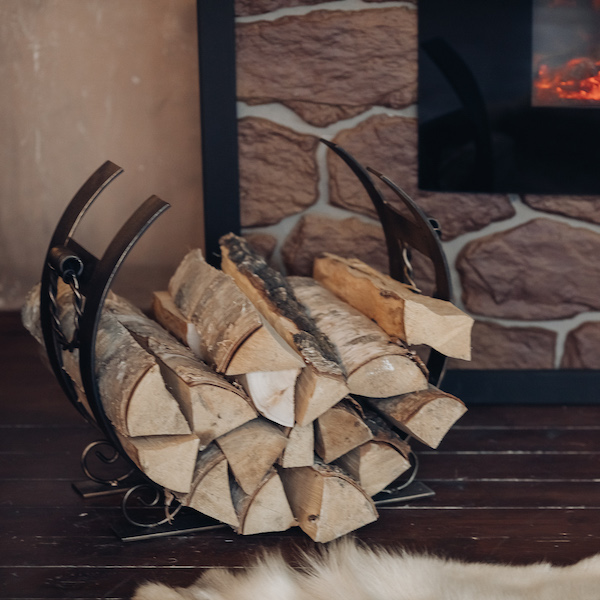
Wood-burning fireplaces have long stopped being a luxury and become an everyday reality, especially for owners of country houses and cottages. A solid-fuel fireplace does not just look striking and cosy — it also saves a great deal of electricity and gas, because it handles the job of heating the home very well.
What determines how long a fireplace will burn?
The first thing every prospective owner wants to know is how long the fire burns in a fireplace and what area a wood-burning fireplace can heat. It all depends on the model of the insert. When buying, pay attention to its output and efficiency. To estimate the area a fireplace will heat, use a simple rule of thumb: 1 kW of insert output = 10 m² of heated floor area.
But the specifications of the insert alone are not enough to predict how long the fire will burn. There is another very important factor — the firewood.
It is the firewood you choose that determines the length of the burn. And different species burn very differently.
How long does firewood burn in a fireplace?
There is no universal answer to the question of which firewood is best. But if a long burn matters to you, choose hard deciduous species: hornbeam, beech, ash, oak, birch, maple, elm. Such wood lights easily, burns long and evenly and produces good embers.
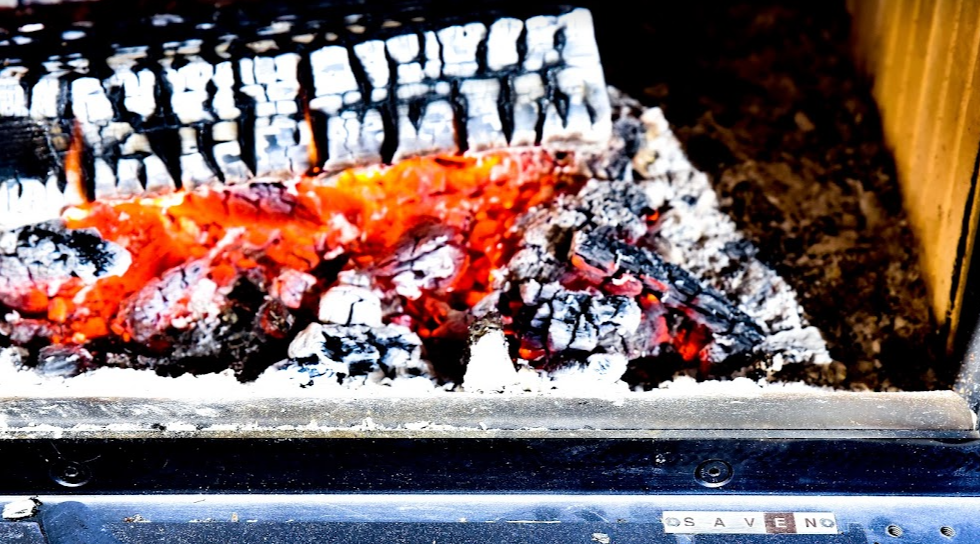
Soft species (poplar, aspen, lime, willow) give a bright flame but burn through noticeably faster from the same volume of the firebox.
Fruit woods (apple, plum, pear, cherry, walnut, chestnut) burn relatively long. The flame from them is bright, crackles slightly and has a distinct pleasant fruity aroma.
Coniferous wood, on the other hand, is not suitable for a long burn. Resinous needlewood flares up and burns away quickly, so there is little efficiency to be had from it — and the resin that does not burn completely settles in the flue.
| Species | Calorific value, kWh/kg | Flame temperature, °C | How it behaves in a fireplace |
|---|---|---|---|
| Hornbeam | 4.2 | 1020 | Dense hardwoods. They keep a stable working temperature in the firebox and, because of their density, give the most heat per cubic metre — which is why they burn the longest from one loading. |
| Beech | 4.2 | 1044 | |
| Ash | 4.2 | 1044 | |
| Oak | 4.2 | 900 | |
| Birch | 4.2 | 816 | Lighter woods. Per kilogram they release about the same energy, but a cubic metre contains far less wood — so the same firebox loading burns down faster. |
| Poplar | 4.2 | 468 | |
| Lime | 4.2 | 660 | |
| Pine | 4.3 | 624 | Burn away quickly and contain a lot of resin, which does not burn off completely and leaves deposits in the flue and inside the firebox. |
| Spruce | 4.3 | 612 |
Why do all species show almost the same figure per kilogram?
This is the point that confuses most people. Dry wood of any species releases roughly the same energy per kilogram — around 4.2 kWh — because chemically it is all much the same material. The difference lies in density: a cubic metre of hornbeam weighs almost twice as much as a cubic metre of poplar.
That is why you buy firewood by volume but burn it by mass. A cubic metre of hardwood gives about 2,800–3,000 kWh, a cubic metre of softwood only 1,450–1,600. The same firebox, filled to the same level, therefore burns for very different lengths of time.
How does moisture affect the burn?
The moisture content of the firewood also affects burning time. Ideally it should be below 20%; otherwise the wood burns poorly, soot appears on the glass, and smoke makes it hard to watch the flame. You can determine the exact moisture content with a moisture meter.
The reason is simple: water in the wood has to be evaporated before the wood itself can burn, and that energy is taken from the fire rather than given to the room. Wood seasoned to 15–20% gives roughly a third more usable heat from the same volume.
If you are choosing an appliance, look at the straight steel inserts, corner inserts and steel fireplace stoves sections — and remember that the flue matters as much as the appliance, so see the chimneys section too.