

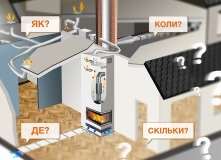
You cannot simply buy a fireplace and stand it in the house. That is not enough for it to work. A wood-burning fireplace is not only the insert and the surround. It also includes such an important element as the chimney. The name itself says what it is: a device for removing smoke. But why is it so important, and how do you avoid going wrong in choosing and installing one?
Let us work out what types of chimney exist in general and which chimney to buy for a fireplace insert in a house.
What types of chimney are there for a private house?
There are several types of chimney installed in houses. They differ from one another in the method of installation, the shape, the size and the construction. The most widespread are brick, steel and ceramic. Each has its own pluses and minuses.
Below is an overview of the main types of chimney that exist on the market at all. This is not a list of our range but a general picture, so that you understand what there is to choose between and why some solutions are widespread while others are rarely met with. Whatever from this list is in our catalogue we have marked separately below — in the section "Which chimneys are in the SAVEN catalogue?".
A brick or stone chimney
One of the most common options. Brick chimneys and stone-built flues were popular long before steel and ceramic ones were built. Brick and stone have established themselves as a reliable and practical material with no equal for availability and price.
A stone flue becomes not only part of the heating system but an addition to the house and an element of the decor.
The pluses of a brick or stone chimney:
- resistance to heat
- a high level of heat capacity and heat conductivity
- strength and durability
- the ideal option for open fireboxes
- inexpensive to build
The minuses of a brick or stone chimney:
- when lighting an insert with a cold brick flue, the draught can be very weak, so smoke may get into the room. The draught will remain weak until the chimney is fully warmed through.
- a brick chimney is quickly fouled by combustion products and needs more frequent cleaning and more careful attention.
- as a result of constant temperature swings the brickwork of the flue can lose its integrity over time, and cracks form on its surface. That is very dangerous from the point of view of fire safety. Soot in the chimney can catch fire, and through the cracks the fire will get into the room. To avoid such a situation a brick chimney should be lined with a stainless steel sleeve.
- the complexity of the building and the masonry. The brickwork must be even and smooth. The bricks are laid so that the vertical joints are covered by the brick of the preceding and following course. That takes effort and time.
Because of the many complications associated with building and using a brick chimney, this option is not especially popular today.
A steel chimney for a fireplace
A metal chimney is one of the most widespread types of flue. Stainless steel flues with a fireclay lining came to replace the old brick chimneys.
Such chimneys are made from pipes of round, or more rarely rectangular, section. Both ordinary and stainless steel can be used as the material. Galvanised steel is not used, because it is short-lived under constant temperature swings — such a chimney would last literally one or two seasons. Stainless steel has proved itself best of all.
Heat-resistant steel chimneys work together with solid-fuel boilers and fireplaces and are ideally suited to that type of heating.
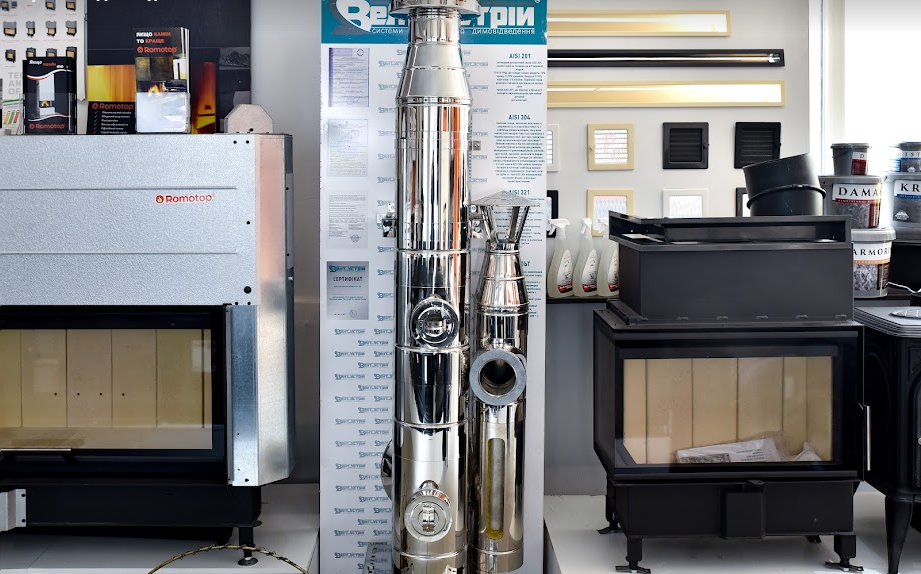
The advantages of a steel chimney:
- Metal is heat resistant and withstands temperatures up to 400°C.
- Simplicity of assembly (one element fits tightly into the socket of the next. To join the chimney to a closed insert, which requires a higher degree of sealing, clamping bands and sealing gaskets are used).
- When erecting steel pipes there is no need to build additional foundations.
- Ideal for closed inserts and fireplace stoves.
- A low probability of draught reversal, smoke entering the room, and large amounts of condensate forming in the pipe.
- Light weight.
- A relatively low cost.
What does the service life of a steel chimney depend on?
- The service life of a steel pipe is not the same for all products. It depends on the grade of steel, the wall thickness, the operating regime (temperature, the type and moisture content of the fuel, the number of firings per season) and the regularity of cleaning. Thin metal in a regime of constant overheating wears out quickly; quality stainless boiler steel of the required thickness, correctly installed and serviced annually, serves for a long time.
- The working temperature range is limited: steel is rated for temperatures up to 400°C, so it is important not to over-fire the insert and to keep the flue clean. It is overheating and a layer of soot, rather than the material itself, that most often shortens the life of a chimney.
A ceramic chimney
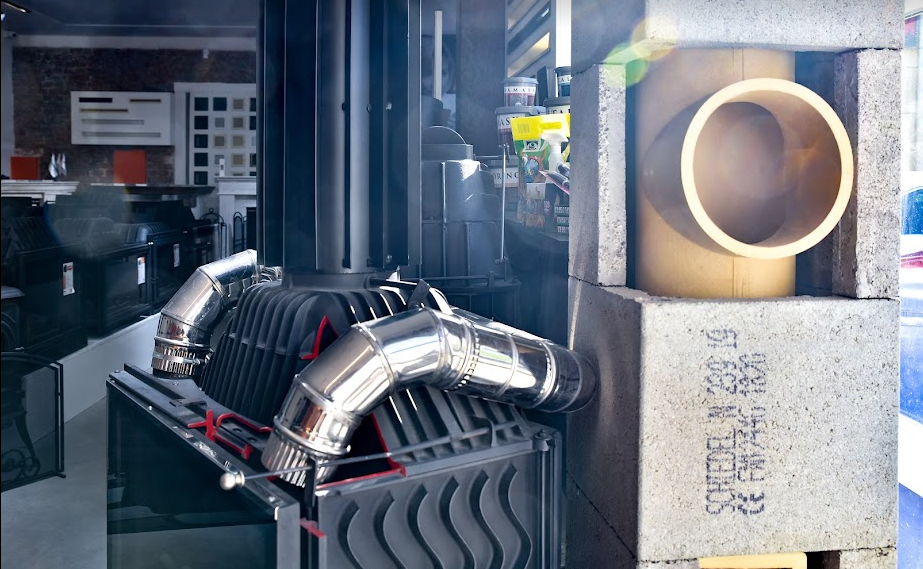
A ceramic chimney is a construction of three layers: an inner ceramic liner, a middle layer with thermal insulation, and an outer layer of concrete blocks. The construction is complex, so it demands professionalism and care during installation, but it provides excellent thermal insulation and a long service life. For wood-burning fireplaces ceramic flues are ideal, since they are more heat resistant.
The advantages of a ceramic chimney:
- An ideally smooth inner surface of the pipes
- A high rate of heating and a long cooling process for the material
- The ability to withstand temperatures up to 1000°C
- A long service life of up to 50 years
The disadvantages of a ceramic chimney:
- considerable weight and the need to build an additional supporting base for the flue
- a high price
Ceramic systems are given here as an overview, as part of the general picture of the market — this type of chimney is not represented in SAVEN's own catalogue.
A glass chimney
A glass chimney undoubtedly attracts attention with its unusual appearance. That allows it to fit into any modern interior.
For glass chimney installations heat-resistant glass is used, resistant to high temperatures and chemical attack. Glass is not subject to corrosion or the effects of damp. Such a flue is resistant to heat and will remove smoke well. The ideally smooth surface of the walls rules out any large accumulation of soot, which simplifies looking after the flue and shortens the time needed for cleaning.
However, a glass chimney is the most expensive and the most difficult option to execute, and one that requires careful handling in use. In practice such a solution is rarely met with, and almost always in individual designer projects.
The pluses of a glass chimney:
- resistant to high temperatures and chemical attack
- not subject to corrosion or the effects of damp
- resistant to heat
- provides good removal of smoke
- simple to look after and clean
- striking in appearance
The minuses of a glass chimney:
- very difficult to install
- very expensive
- requires careful handling in use
Glass chimneys are described here as an overview, for completeness — this type of chimney is not represented in SAVEN's own catalogue.
A modular chimney
A modular chimney is made from special modular blocks of standard size and weight. Such chimney systems are fireproof and have a high degree of heat resistance. A flue of this kind will serve 20-25 years. Modular chimneys are most often installed in timber buildings, where the threat of fire is extremely high.
Depending on the material, modular flues come in two kinds:
- made of concrete blocks that have insulation and a ceramic pipe inside. They are characterised by versatility of use in any heating system.
- made of modular blocks based on volcanic pumice. It helps to reduce heat losses from the flue gases along the whole length of the chimney. For this chimney system to work no insulation or pipes are needed at all — the modules themselves are entirely sufficient for the system to function fully.
The advantages of a modular chimney:
- moisture resistance and acid resistance
- resistance to temperature swings
- the absence of corrosion
- suits any heating system
The disadvantages of a chimney of modular blocks:
- expensive
- not simple to install
Block modular systems (concrete with a ceramic pipe, volcanic pumice) are covered here as an overview — they are not represented in SAVEN's own catalogue.
What are the advantages and limitations of the different types?
So that you do not have to scroll back and forth through the text, we have gathered everything written above into a single comparison table.
| Type of chimney | Advantages | Limitations |
|---|---|---|
| Brick / stone | Resistant to heat; high heat capacity and heat conductivity; strong and durable; suits open fireboxes; inexpensive to build; can be a decorative element of the house | Weak draught until the flue is fully warmed, smoke can enter the room; fouls with soot quickly and needs more frequent cleaning; temperature swings cause cracks (a stainless steel liner is needed); complex, labour-intensive masonry |
| Steel (stainless) | Heat resistance to 400°C; simple socket-into-socket assembly; needs no separate foundation; ideal for closed inserts and fireplace stoves; a low probability of draught reversal and condensate; light weight; relatively low cost | Working temperature no higher than 400°C; service life depends on the grade and thickness of the steel, the operating regime and the regularity of cleaning; galvanised steel is unsuitable for a chimney at all |
| Ceramic | An ideally smooth inner surface of the pipes; heats up quickly and holds heat for a long time; withstands up to 1000°C; service life up to 50 years | Considerable weight and the need for an additional supporting base; a high price; complex installation requiring qualification |
| Glass | Resistant to high temperatures and chemical attack; unafraid of corrosion and damp; removes smoke well; smooth walls mean less soot and simpler cleaning; a striking look in a modern interior | The most difficult to install; the most expensive of all the options; requires careful handling in use |
| Modular (block) | Moisture resistance and acid resistance; resistance to temperature swings; the absence of corrosion; suits any heating system; serves 20-25 years | Expensive; not simple to install; because of the weight of the blocks it needs a prepared base |
Which chimneys are in the SAVEN catalogue?
Of everything in the list above we deliberately work with one direction — steel chimney systems. The reason is simple: steel goes best of all with the closed fireplace inserts and fireplace stoves we manufacture, it is installed without a separate foundation, and it gives a predictable draught.
The elements of the chimney — pipes, elbows, tees, inspection doors, fixings and terminal parts — are gathered in the CHIMNEYS section. There they can be matched to the required diameter and routing, rather than assembling a system from random components by different manufacturers.
A chimney is chosen not on its own but together with the heating appliance. So it is worth deciding on the insert or stove first: look at straight steel fireplace inserts, corner inserts or steel fireplace stoves, and only then select the chimney system to suit the outlet spigot of the model you have chosen.
As for the cost of a chimney set — please check prices with a manager or a representative in your region: the final figure depends on the diameter, the length of the run and the number of shaped elements.
What should a chimney for a wood-burning fireplace be like?
The first thing to know before you buy a chimney for a wood-burning fireplace is that there is no universal solution. The chimney system for every fireplace is unique and is selected according to the construction of the insert, the parameters of the room and many other factors.
That is exactly why the installation of a chimney for a fireplace is better entrusted to qualified fitters. The proper functioning of the fireplace, fire safety, the integrity of your property and even the life and health of you and your family depend on the quality of the materials used and on the knowledge and professionalism of those doing the work.
So a chimney should be chosen comprehensively, taking the following details into account:
- the type of insert
- the diameter of the chimney
- the height of the chimney
- the material of the chimney
- the shape of the chimney's cross-section
- the inner surface of the chimney
- its placement within the house
What are the requirements for installing a chimney?
Despite the fact that a chimney is calculated individually for each heating appliance and each room, there are also general requirements for chimneys serving wood-burning fireplace inserts and stoves:
- the material of the chimney must be fire resistant (best of all — choose stainless boiler steel);
- the most suitable shape for a chimney is cylindrical. The more corners a flue has, the more soot accumulates in them, so a cylindrical shape ensures the unimpeded passage of smoke;
- smoke from the fireplace should be led away through a straight vertical flue with a minimum of inclined sections;
- a chimney must not be installed within external walls. In our climate that is categorically forbidden, since there is a risk that in winter the pipe will freeze through and give a reversed draught;
- the diameter of the flue depends on the dimensions of the insert. The diameters most often met with are 180 mm, 200 mm, 300 mm and even 500 mm;
- the height of the flue pipe should on average be no less than 5-7 m from the surface where the fuel burns;
- the position of the chimney above the roof must be no lower than the level of the ridge, and preferably 0.5 m higher or more;
- the chimney should be placed 1.5 m or more from the roof ridge horizontally;
- for flat roofs the flue pipe is taken to a height of at least 1 m above the level of the roof;
- the cross-section of the chimney should be from 1/15 to 1/10 of the firebox opening, usually no less than 14×14 cm (for a construction of square section);
- the place where the chimney passes through timber floors and other combustible structures must be insulated;
- the external part of the chimney must be fixed in place and protected from the wind with a special cowl;
- the temperature of the chimney must not exceed 800°C;
- the chimney system must have fireplace ventilation grilles for hot air to leave and cold air to enter;
- a cowl is fitted to improve the draught, but its effect extends only to windy weather.
Where do you start when choosing a chimney?
The shortest practical order of actions is this: first you choose the heating appliance and look at the diameter of its outlet spigot; next you assess where exactly the pipe will pass through the floors and the roof covering and what height it must be; and only then do you specify the system. The ready elements for that are gathered in the chimneys section, and the heating appliances themselves in the fireplaces and stoves section. If you have any doubts about the diameter or the routing, it is better to agree the specification with a manager or a representative in your region straight away than to rebuild a run that has already been installed.