

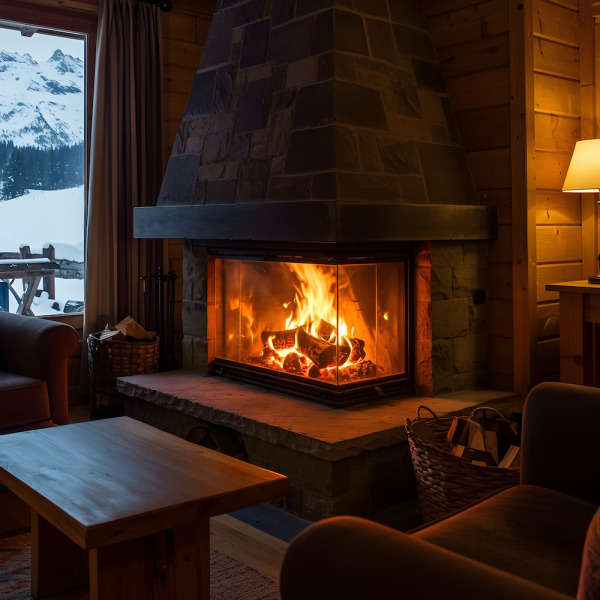
Winter frosts are a real test for your fireplace system. Even a properly installed fireplace requires regular checks before the cold season. Preparing your fireplace for winter is not a formality; it ensures safe, efficient, and stable operation of the equipment during the coldest days.
In this article, we’ll explain what exactly needs to be checked so that your fireplace in frost works without issues and winter fireplace use remains comfortable and safe.
Why preparing your fireplace for winter is critically important
During winter, a fireplace:
- operates more intensively and for longer periods;
- faces large temperature fluctuations;
- depends on stable draft and proper ventilation.
Ignoring preventive maintenance often leads to:
- smoke entering the room;
- reduced efficiency;
- increased soot formation;
- risk of overheating or accidents.
1. Chimney: the first thing to check
Chimney cleanliness
Before the frosts, the chimney must be cleaned.
Pay attention to:
- soot and deposits;
- residual condensation;
- foreign objects or bird nests.
Even a thin layer of soot reduces draft and complicates winter fireplace use.
Chimney insulation
In severe frost, an uninsulated chimney can:
- cool the flue gases too quickly;
- cause condensation;
- reduce draft.
Recommendation: check the integrity of the insulation and the tightness of the joints.
2. Draft: how to know if there’s a problem
Poor draft is one of the most common winter issues.
Signs of insufficient draft:
- smoke enters the room when lighting the fire;
- the flame "chokes";
- logs smolder instead of burning properly.
Causes in winter:
- cold chimney;
- strong wind;
- sharp temperature differences;
- blocked air supply.
Before severe frosts, do a test fire and observe the flame behavior.
3. Ventilation: the fireplace won’t work properly without it
A fireplace requires a stable air supply for combustion and efficient convection.
What to check:
- availability of fresh air supply;
- no blocked channels;
- correct operation of the convection chamber.
In winter, windows and doors are often tightly closed — this worsens fireplace performance.
4. Ventilation grilles: a small detail that makes a big difference
Ventilation grilles play a key role in heat distribution.
Make sure that:
- grilles are not blocked by furniture or decor;
- there is no dust buildup;
- proper orientation is maintained (top — for warm air outlet, bottom — for cold air intake).
Blocked grilles lead to:
- overheating of the cladding;
- reduced efficiency;
- uneven room heating.
5. Fireplace body and cladding
Before frosts, inspect:
- joints and seams of the cladding;
- absence of cracks;
- integrity of thermal insulation materials.
Sharp temperature changes in winter can exacerbate existing defects.
6. Test fire before frosts: a mandatory step
Before stable cold weather arrives:
- Light the fireplace at a moderate level.
- Check the draft and smoke outlet.
- Inspect cladding heating.
- Observe the performance of ventilation grilles.
This test helps identify problems before the fireplace is needed daily.
Typical winter mistakes:
- Lighting the fireplace “at full power” on the first day of frost
- Using wet logs
- Blocking ventilation openings
- Lack of regular chimney inspection
All of these directly affect safety and efficiency.
Conclusion
Preparing your fireplace for winter is a comprehensive check of the chimney, draft, ventilation, and ventilation grilles. These elements determine how your fireplace in frost will perform and how comfortable winter fireplace use will be.
A few hours of preventive maintenance in autumn or early winter ensure:
- stable heat;
- safe operation;
- maximum fireplace efficiency even in severe frosts.
A warm home in winter starts with a properly prepared fireplace.