

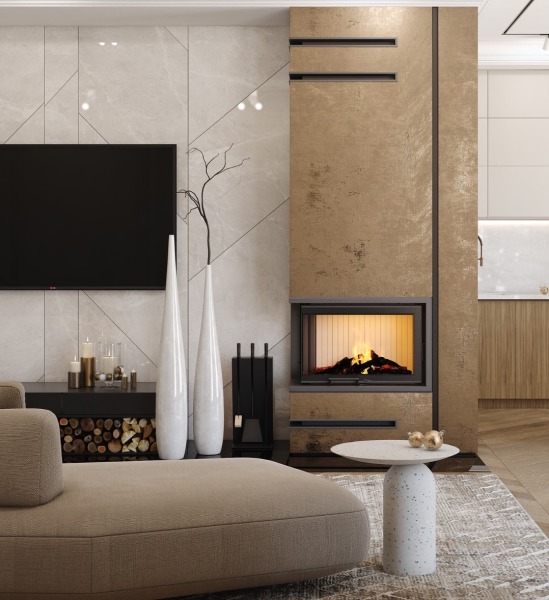
The idea of placing a TV above a fireplace has long become popular in modern interiors. It looks aesthetic, saves space, and creates a unified visual composition. However, along with design comes a key question: is it safe from a technical point of view?
Incorrect installation can lead to overheating of the equipment, reduced TV lifespan, or even complete failure. In this guide, we will look at real temperatures above a fireplace, installation rules, ways to protect a TV from heat, and recommendations from designers and fireplace manufacturers.
Can you install a TV above a fireplace: a short answer
Yes, a TV above a fireplace can be installed, but only if the fireplace enclosure, ventilation, and thermal protection are properly designed.
Key factors:
- type of fireplace insert;
- fireplace power output;
- presence of convection;
- installation height;
- operating temperature above the fireplace.
Temperature above the fireplace: what real measurements show
Critical temperatures for TVs
Most TV manufacturers (Samsung, LG, Sony) specify:
- maximum operating temperature: +35…+40 °C
- exceeding this value reduces the lifespan of electronics
Actual temperature above the fireplace
According to practical measurements:
- without ventilation: 60–90 °C
- with improper ventilation: 45–60 °C
- with proper convection and thermal protection: 30–38 °C
Conclusion: a TV can only be placed in a controlled temperature zone.
TV zones above the fireplace: where it’s safe and where it’s not
Conventionally, the space above a fireplace is divided into three zones:
Direct heat impact zone (dangerous)
- directly above the fireplace opening;
- temperature may exceed 70 °C;
- TV installation is prohibited.
Transition zone
- middle section of the enclosure;
- temperature is unstable;
- installation is possible only with additional protection.
Safe zone
- above the hot air outlet zone;
- temperature is stable;
- TV installation is allowed.
Minimum distances for installing a TV above a fireplace
There is no universal value, but in practice the following guidelines are used:
- minimum distance from the fireplace opening to the bottom edge of the TV — 600–800 mm;
- mandatory presence of outlet ventilation grilles between the fireplace and the TV;
- the TV must not block ventilation openings.
For high-power fireplace inserts (10–14 kW), the distance is increased individually.
How to protect a TV from heat: effective solutions
The question how to protect a TV from heat is crucial, as only a set of measures guarantees safety.
1. Proper ventilation of the fireplace enclosure
- intake grilles — at the bottom;
- outlet grilles — at the top;
- additional ventilation of the decompression chamber.
This allows hot air to be removed before it reaches the TV.
2. Heat-deflecting shelf or thermal screen
A fireplace mantel or special deflector:
- blocks the heat flow;
- redirects hot air forward;
- reduces the temperature in the TV zone by 10–20 °C.
3. Heat-resistant materials in the cladding
Recommended materials include:
- insulation boards (Isol, calcium-silicate boards);
- minimal use of uninsulated metal;
- cladding with controlled thermal conductivity.
4. Active or passive ventilation
In complex projects, the following are used:
- convection ducts;
- additional ventilation grilles;
- forced ventilation (if required).
Temperature calculation: simplified practical logic
Although precise calculations are performed by engineers, in practice the following principles apply:
- the higher the fireplace power, the more ventilation openings are required;
- the smaller the ventilation area, the higher the temperature above the fireplace;
- lack of outlet grilles = enclosure overheating.
That is why fireplace manufacturers, including SAVEN, always specify the minimum required ventilation grille area for each model.
Common mistakes when installing a TV above a fireplace
Installation without ventilation
Leads to overheating in the very first heating season.
TV placed too close to the fireplace
Even modern models are not designed for constant heat exposure.
Blocking ventilation grilles
The most dangerous mistake — blocking the hot air outlet.
Lack of a heat-deflecting shelf
Especially critical for high-power fireplaces.
Designers’ recommendations: combining safety and aesthetics
Professional designers recommend:
- visually combining the fireplace and TV while functionally separating them;
- using niches with an air gap;
- avoiding glossy surfaces without thermal insulation;
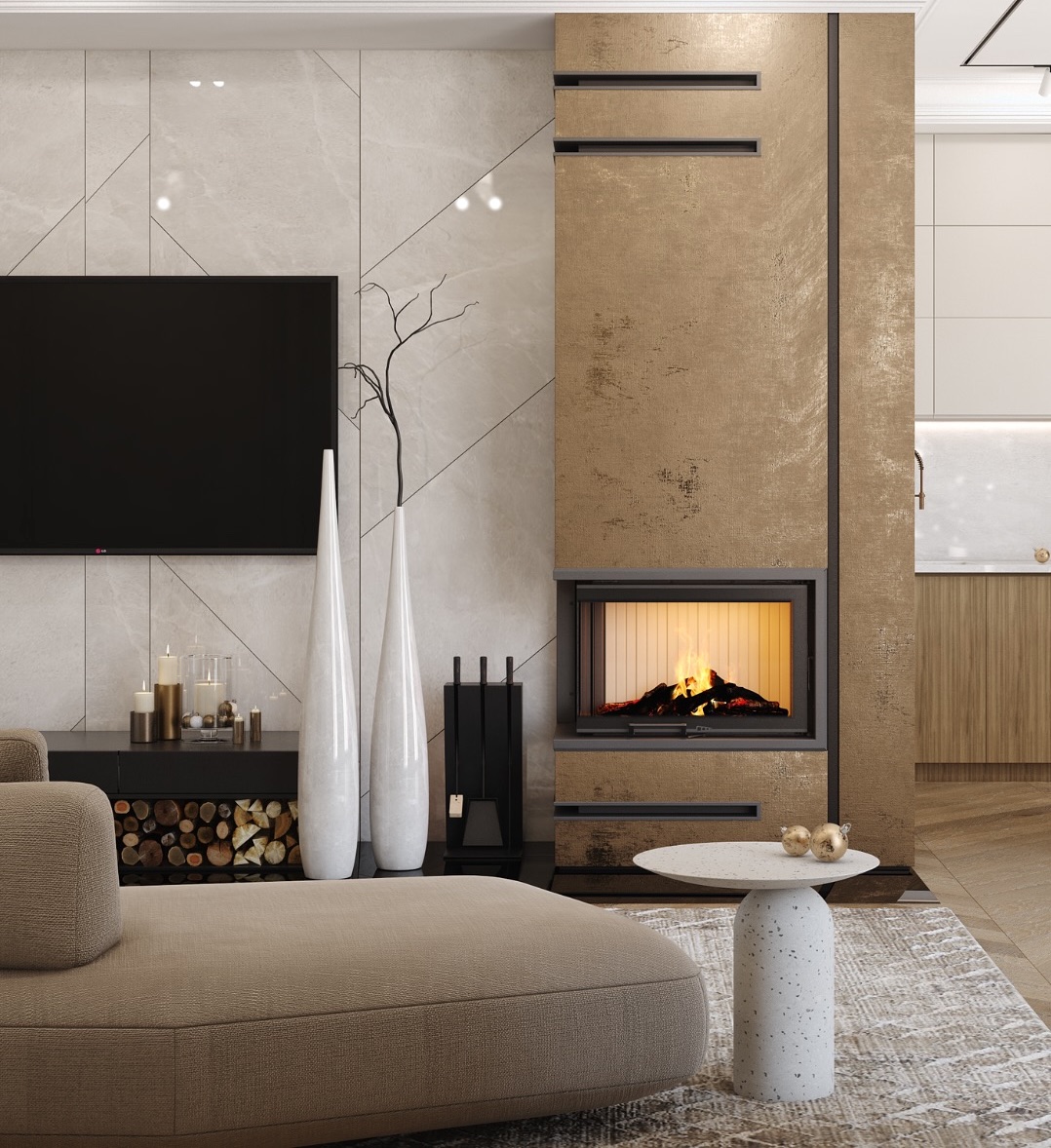
- designing the fireplace and TV at the design stage, not after installation.
When a TV above the fireplace is not the best solution
There are situations where it is better to choose an alternative:
- very high-power fireplace insert;
- low ceilings;
- no possibility to create proper ventilation.
- In such cases, it is better to:
- move the TV to an adjacent wall;
- install it on a swivel mount;
- place it in a separate niche.
Conclusion
Combining a fireplace and a TV is possible, but it requires an engineering approach. Understanding the temperature above the fireplace, proper ventilation design, and compliance with thermal protection zones allow you to:
- safely install a TV;
- preserve its lifespan;
- achieve a comfortable and stylish interior.
When everything is done correctly, a TV above the fireplace becomes not a risk, but a well-thought-out design solution.